




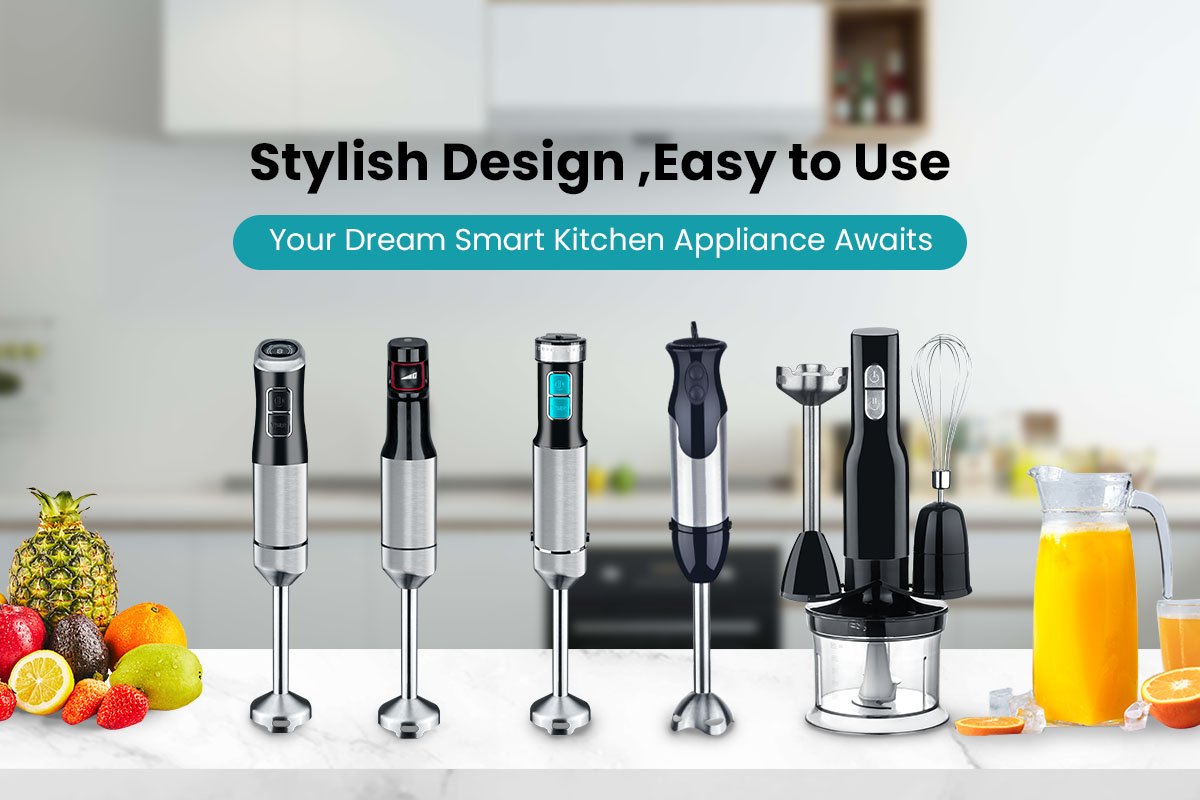
Can You Blend Ice Cubes With A Hand Blender
Blending ice cubes with a Hand Blender is possible in certain cases, but it depends entirely on motor torque, blade design, shaft strength, and load protection system. Not all hand blenders are engineered for hard-material crushing. Using an underpowered unit to crush ice can lead to motor burnout, blade deformation, coupler wear, or shaft bending.
For professional buyers evaluating product platforms for international markets, ice-crushing capability should be validated through engineering testing—not assumed from wattage claims alone.
1. What Ice Crushing Requires From A hand blender
Ice is significantly harder than soft food ingredients. Crushing it requires:
High torque output at startup
Reinforced stainless steel blades
Impact-resistant shaft connection
Strong coupler and gearbox structure
Overload or thermal protection system
Standard blending tasks (soups, sauces, smoothies) involve low resistance. Ice introduces shock load, which stresses mechanical and electrical components.
2. Motor Power Is Not The Only Factor
Many suppliers advertise higher wattage as proof of ice capability. However, wattage alone does not determine performance.
Buyers should evaluate:
Real torque output under load
Motor winding stability
Heat-rise control during impact load
Start-up current surge tolerance
Thermal cut-off response time
A factory with in-house motor production and testing capability can verify these parameters through controlled load simulation instead of relying on nominal power ratings.
3. Blade And Shaft Engineering
Ice crushing places stress on blade edges and shaft joints.
Key design considerations:
Hardened stainless steel blade material
Thickened blade profile
Reinforced shaft connection
Precision shaft alignment
Low runout tolerance to reduce vibration
If blade geometry is optimized only for emulsification, it may chip or deform under ice impact.
OEM development should include endurance testing with repeated ice-crush cycles.
4. Coupler And Gear Durability
One of the most common failure points during ice blending is the coupler between motor and shaft.
Buyers should confirm:
Coupler material type
Wear resistance testing
Impact cycle validation
Gear alignment consistency
Factories with integrated hardware processing and assembly control are better positioned to maintain tight tolerances and mechanical durability across production batches.
5. Manufacturing Process Overview
Reliable ice-capable hand blenders typically undergo:
Motor performance inspection
Blade hardness verification
Shaft straightness testing
Coupler installation torque control
Load simulation under hard-material testing
Electrical insulation safety testing
Final noise and vibration evaluation
Integrated production systems reduce inconsistency and mechanical tolerance stacking.
6. Manufacturer vs Trader Risk
Traders sourcing finished products from multiple subcontractors often cannot:
Modify blade hardness specifications
Upgrade motor torque profile
Adjust coupler material grade
Conduct structured endurance testing
A direct manufacturer with injection, hardware, motor, and assembly workshops can optimize the complete power transmission system for ice-crushing performance.
7. Material Standards And Food Safety
Even when crushing ice, food-contact standards remain critical:
Food-grade stainless steel for blades and shafts
BPA-compliant plastic components
Corrosion resistance against moisture
Certification documentation for export markets
Ice exposure accelerates condensation and internal moisture risk, making corrosion resistance important.
8. Export Market Compliance
Before placing bulk orders, confirm:
Electrical safety certification for target country
Overheat protection validation
Labeling compliance
Batch traceability system
Spare parts availability
Impact-load usage increases warranty claim risk if compliance and testing are insufficient.
Bulk Sourcing Checklist For Ice-Capable Models
Confirm supplier is a true manufacturer with in-house engineering control.
Request load test data specifically for ice crushing.
Verify blade hardness and shaft tolerance documentation.
Review motor heat-rise performance reports.
Confirm coupler wear-cycle test results.
Validate export compliance documentation.
Define AQL limits for vibration and noise defects.
Structured evaluation reduces post-shipment failure rates.
Conclusion
Some hand blenders can crush ice, but only models engineered with sufficient torque, reinforced blades, durable couplers, and validated overload protection systems should be used for this purpose. Using a standard low-duty immersion blender for ice may lead to premature failure.
For importers and distributors, partnering with a manufacturer that controls motor production, blade engineering, structured quality testing, and export compliance systems ensures consistent performance and long-term supply reliability in international markets.