




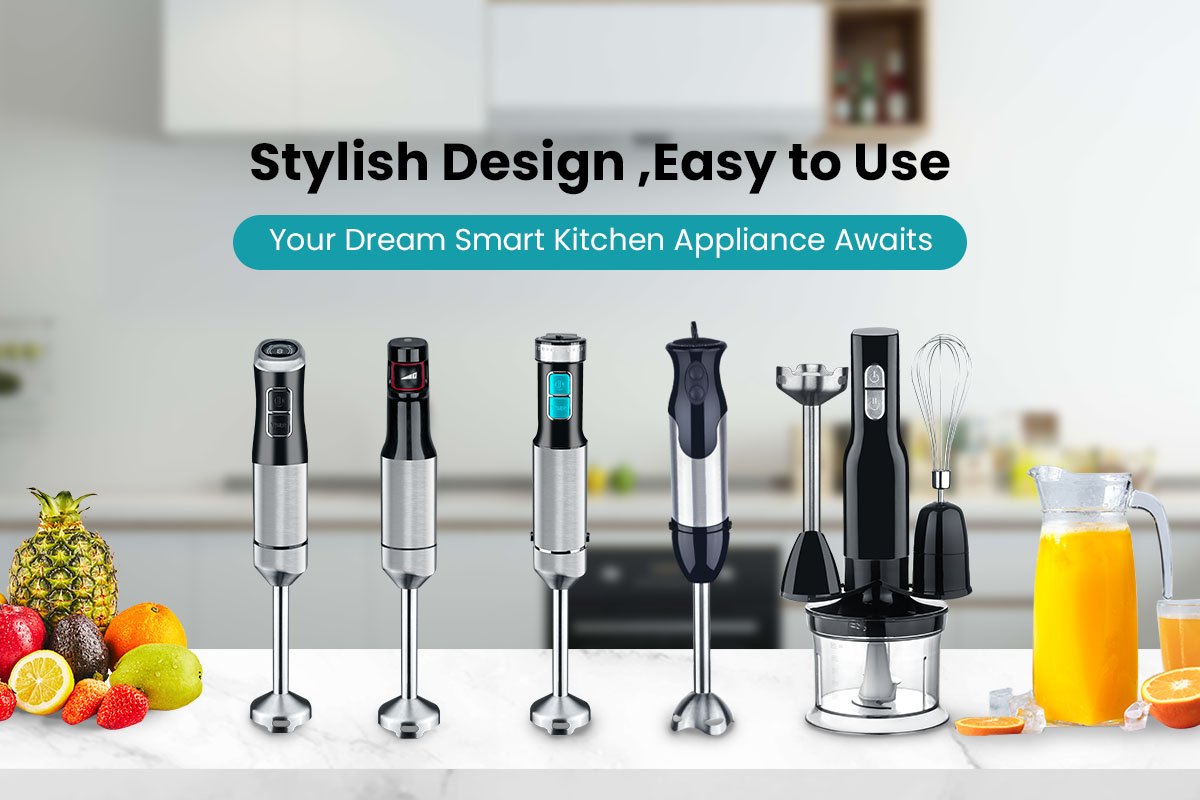
Can You Make Baby Food With A Hand Blender
Yes, you can make baby food with a Hand Blender, and this is one of the most common household applications for immersion blenders. Cooked vegetables, fruits, and soft proteins can be pureed directly into smooth textures suitable for infant feeding.
However, from a product engineering and sourcing perspective, baby food preparation requires fine blending performance, food-contact safety compliance, easy cleaning, and stable motor control. Importers and distributors positioning hand blenders for this use should evaluate more than basic blending capability.
1. Why hand blenders Are Suitable For Baby Food
Baby food preparation requires:
Smooth, lump-free texture
Controlled blending speed
Small-batch processing
Easy cleaning and sanitation
An Immersion Hand Blender allows parents to:
Blend directly in cooking containers
Control texture consistency
Process small portions
Avoid transferring hot food
The vertical immersion design also reduces food waste.
2. Motor Control And Texture Precision
Baby food often requires ultra-smooth consistency.
Buyers should assess:
Stable motor torque at low and medium speeds
Variable speed control
Reduced vibration for fine blending
Thermal protection during extended blending cycles
Consistent rotational speed helps prevent uneven puree texture.
Manufacturers with in-house motor production and testing facilities can validate blending smoothness under controlled vegetable puree simulation.
3. Blade Design And Shaft Engineering
For baby food applications, blade geometry plays a critical role.
Key factors include:
Precision-balanced stainless steel blades
Fine-cutting blade profile
Anti-splash guard design
Accurate shaft alignment
Improper blade balance can create vibration and inconsistent texture.
OEM programs should include puree smoothness testing with cooked vegetables such as carrot or sweet potato.
4. Food-Contact Material Standards
Because baby food involves direct infant consumption, compliance is critical.
Confirm:
Food-grade stainless steel blades and shafts
BPA-free plastic components
Certification documentation for food-contact materials
Resistance to corrosion from fruit acids
Export markets often require material declarations and safety documentation.
5. Cleaning And Hygiene Design
Baby food preparation demands easy sanitation.
Evaluate:
Detachable blending shaft
Smooth surface finish without deep crevices
Dishwasher-safe components (if applicable)
Seal resistance to moisture
Design simplicity improves hygiene and reduces bacterial risk.
6. Manufacturer vs Trader Considerations
When sourcing hand blenders for baby food positioning, buyers should confirm:
Does the supplier control motor assembly?
Are food-contact materials verified at factory level?
Are load and smoothness tests performed before shipment?
Is quality inspection integrated into production?
Factory-based manufacturers with integrated injection, hardware, motor, and assembly workshops can maintain tighter control over food-safety standards and blending performance consistency.
7. Manufacturing Process And Quality Control
A robust production process should include:
Motor torque and speed validation
Blade hardness verification
Shaft straightness inspection
Food-contact material compliance review
Electrical insulation testing
Final functional blending test
Noise and vibration inspection
Structured process control reduces performance variation across production batches.
8. Bulk Project Sourcing Checklist
Before placing large orders:
Test puree smoothness using real baby food recipes.
Validate low-speed control stability.
Review material compliance documentation.
Confirm heat-rise testing results.
Define acceptable vibration thresholds.
Verify spare part availability.
Confirm export safety certification alignment.
Proper validation reduces product returns and compliance risk.
Conclusion
Yes, a hand blender is well-suited for making baby food when equipped with stable motor control, precise blade geometry, and certified food-contact materials. Smooth texture performance, hygiene design, and thermal stability are key performance factors.
For importers and distributors, selecting a manufacturer with integrated motor production, structured quality control checkpoints, certified material standards, and export-compliant production systems ensures reliable puree consistency and long-term supply stability in international markets.