




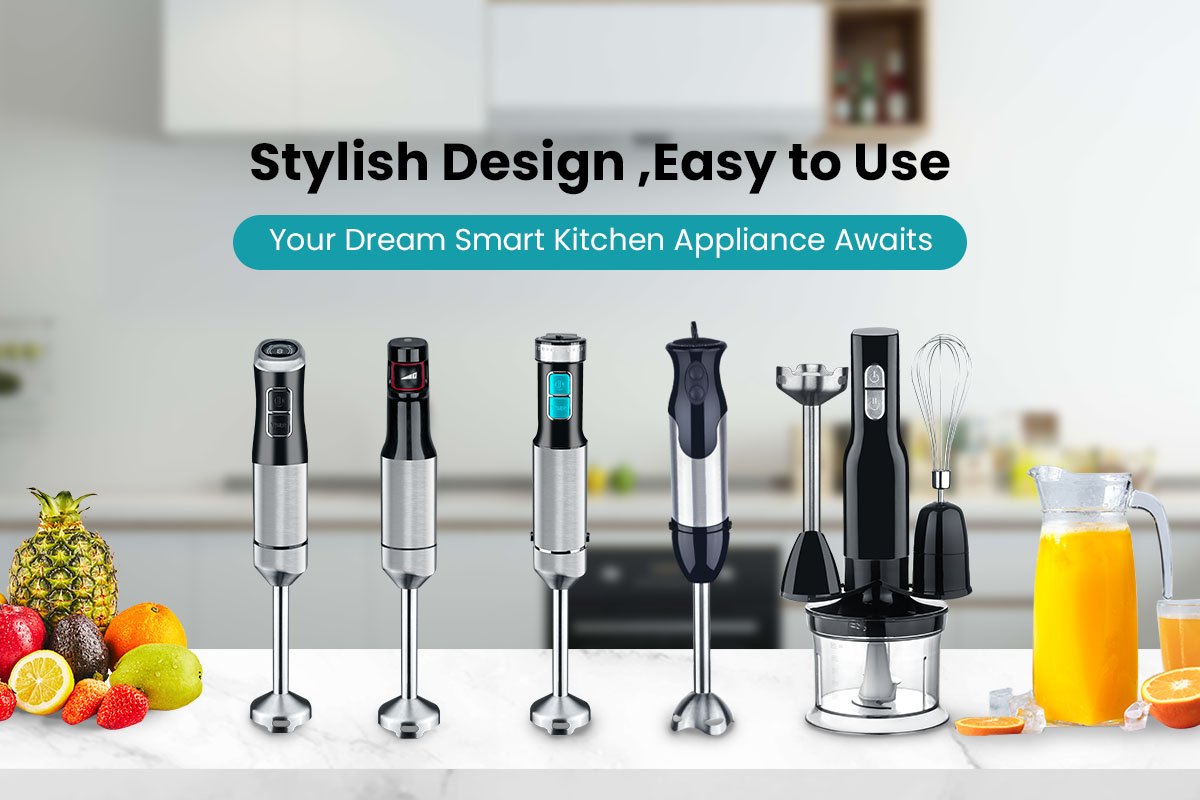
Can You Make Cauliflower Rice With A Hand Blender
Yes, you can make cauliflower rice with a Hand Blender—but only under controlled conditions and preferably with a dedicated chopper attachment. A standard immersion blade shaft is not ideal for dry pulsing of firm vegetables. However, a hand blender equipped with a sealed chopping bowl and pulse control can process cauliflower florets into rice-sized granules efficiently.
For importers and appliance distributors, the more important evaluation is whether the product platform is engineered for short-burst vegetable chopping without excessive motor strain, vibration, or mechanical wear.
1. Why Cauliflower Requires Pulse Control
Cauliflower is:
Dense but not hard like nuts
Low moisture
Fibrous
Easily over-processed into puree
To achieve rice-like texture, the appliance must allow short pulse cycles rather than continuous blending. Continuous high-speed rotation will quickly turn cauliflower into paste.
2. Blade Shaft vs Chopper Bowl
Immersion Blade Shaft
Not recommended for dry cauliflower
Creates uneven texture
Difficult to control granule size
Risk of splashing
Chopper Bowl Attachment
Enclosed cutting chamber
More uniform chopping
Safer for dry ingredients
Better portion control
For cauliflower rice applications, the chopper attachment is strongly preferred.
3. Motor And Torque Requirements
Cauliflower chopping involves intermittent resistance.
Buyers should assess:
Stable startup torque
Pulse speed responsiveness
Overheat protection
Gear and coupler durability
Although lighter than nut crushing, repeated vegetable chopping can strain lower-grade gear systems.
Manufacturers with in-house motor assembly and testing capability can simulate vegetable pulse cycles to validate durability.
4. Blade And Coupler Durability
Critical performance factors include:
Hardened stainless steel blade material
Balanced blade geometry
Accurate shaft alignment
Reinforced coupler design
Poor alignment increases vibration and reduces product lifespan.
OEM development should include repetitive pulse testing under vegetable load conditions.
5. Manufacturing Process Control
A structured production process typically includes:
Injection-molded housing tolerance control
Motor torque validation
Gear alignment inspection
Blade hardness verification
Functional vegetable-load simulation
Noise and vibration measurement
Electrical safety inspection
Integrated production lines reduce mechanical inconsistency across bulk batches.
6. Manufacturer vs Trader Considerations
When sourcing for vegetable-chopping functionality, buyers should confirm:
Does the supplier control motor and gearbox assembly?
Are attachments engineered internally?
Are vegetable-load endurance tests conducted?
Is coupler durability validated before shipment?
Factory-based manufacturers generally offer stronger engineering control than intermediaries.
7. Material Standards And Food Safety
For cauliflower processing, confirm:
Food-grade stainless steel blade certification
BPA-free chopper bowl materials
Corrosion-resistant shaft
Documentation for export food-contact compliance
Vegetable acids and moisture can accelerate corrosion in low-grade materials.
8. Bulk Sourcing Checklist
Before placing bulk orders:
Test cauliflower pulse performance with sample units.
Confirm granule consistency after short cycles.
Review motor heat-rise data.
Verify coupler wear-cycle testing results.
Define acceptable vibration limits.
Confirm spare chopper availability.
Validate export compliance documentation.
Structured validation reduces warranty claims and ensures consistent user experience.
Conclusion
Yes, you can make cauliflower rice with a hand blender—provided it includes a proper chopper attachment and supports controlled pulse operation. Using only the immersion shaft is not recommended for dry chopping.
For importers and distributors, partnering with a manufacturer that integrates motor production, attachment engineering, structured load testing, certified food-contact materials, and export-compliant production systems ensures reliable vegetable-chopping performance and long-term supply stability in international trade.