




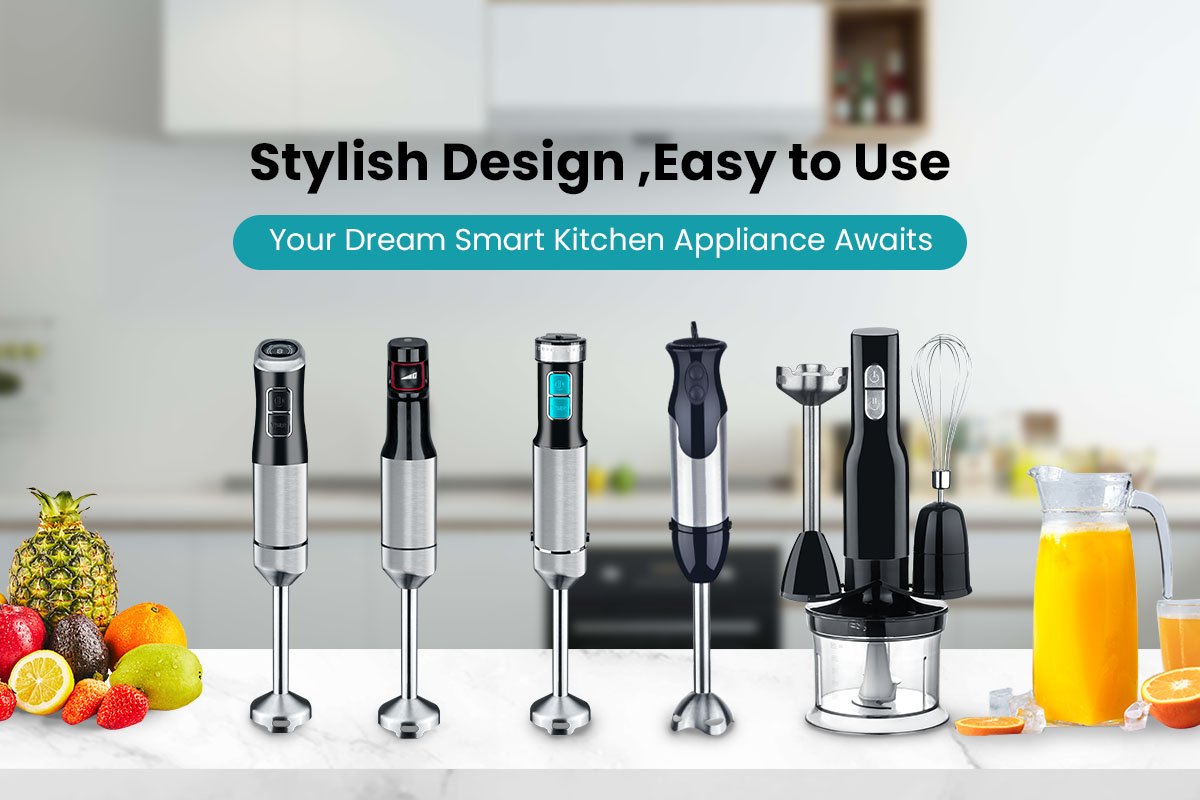
What Factors Affect Blender Pricing In Bulk Orders
Blender pricing in bulk orders is influenced by many factors beyond the product itself. Motor performance, materials, customization requirements, production quantity, certification standards, packaging, and manufacturing processes all affect the final cost.
For a professional blender manufacturer, accurate pricing requires understanding the complete production process. KANGJIA specializes in small home appliance manufacturing, with product categories covering Hand Blenders, Table Blenders, Nutrition Blenders, mini choppers, and more. With integrated production capabilities including injection molding, hardware processing, motor production, assembly, R&D, and testing, KANGJIA can better control production costs and quality consistency. (KANGJIA)
Manufacturer vs Trader: Why Pricing Structures Are Different
One important factor affecting blender pricing is whether the product comes directly from a manufacturer or through a trading company.
A trading company usually adds additional service costs because production is managed through external suppliers. A direct kitchen appliance manufacturer can control more production stages, including:
Component sourcing
Manufacturing processes
Quality inspection
Production scheduling
Packaging preparation
Direct factory cooperation allows pricing to be based on actual production conditions rather than multiple supply chain layers.
For bulk orders, manufacturers can also optimize production methods according to quantity, product specifications, and customization requirements.
Manufacturing Process Overview And Cost Factors
A blender is made from multiple systems, including the motor, circuit board, blade assembly, container, housing, and accessories. Each part contributes to the final product cost.
| Cost Factor | How It Affects Blender Pricing |
|---|---|
| Motor Power | Higher power motors require stronger components |
| Materials | Premium materials increase product durability |
| Product Structure | Complex designs require more manufacturing processes |
| Quantity | Larger orders improve production efficiency |
| Customization | New designs require additional development |
| Certification | Testing and compliance affect project costs |
A professional blender manufacturer evaluates these factors together instead of calculating price only from product appearance.
Motor Performance And Component Selection
The motor is one of the most important cost factors in blender production.
Different motor specifications affect:
Power output
Rotation speed
Noise performance
Heat control
Service life
For example, a compact household blender may use a different motor configuration compared with a high-speed professional blender.
KANGJIA provides different blender solutions with various power configurations, including Electric Blenders, high-speed blenders, and multifunction models, allowing product specifications to match different applications. (KANGJIA)
Other components also influence pricing:
Blade System
Blade costs depend on:
Stainless steel grade
Blade structure
Manufacturing precision
Container Materials
Different container options affect pricing, including:
Plastic containers
Food-grade materials
Glass jars
Housing Materials
Engineering plastics with better strength, heat resistance, and appearance quality may increase production costs.
OEM And ODM Process Impact On Pricing
Customization level is another major factor affecting bulk blender pricing.
Standard OEM Production
For existing models, pricing is usually influenced by:
Order quantity
Packaging requirements
Product configuration
This type of project usually has lower development costs because the product structure already exists.
Customized ODM Development
A customized OEM blender manufacturer needs to consider additional costs related to:
Industrial design
Mold development
Prototype production
Engineering evaluation
Certification testing
New product development requires more resources before mass production begins.
Bulk Supply Considerations For Blender Pricing
Order quantity directly affects production efficiency.
| Order Quantity | Pricing Influence |
|---|---|
| Small Volume | Higher unit cost due to limited production efficiency |
| Medium Volume | Better balance between cost and flexibility |
| Large Volume | Lower unit cost through optimized production |
A reliable bulk blender supplier can provide better pricing through:
Stable material purchasing
Production line optimization
Efficient assembly planning
Long-term supply management
However, the lowest price is not always the best option. Product consistency, quality control, and supply stability are equally important.
Quality Control And Its Impact On Cost
Quality management affects both production cost and long-term product value.
A professional factory needs inspection procedures throughout production.
Material Inspection
Factories check:
Plastic quality
Motor components
Electronic parts
Stainless steel parts
Production Inspection
Manufacturers monitor:
Assembly accuracy
Electrical connections
Product appearance
Functional performance
Final Testing
Before shipment, products are tested for:
Motor operation
Speed control
Electrical safety
Continuous working performance
According to IEC 60335 safety requirements for household electrical appliances, manufacturers need to evaluate electrical safety and reliability before products enter international markets.
Strong quality control may slightly increase manufacturing costs but helps reduce after-sales problems caused by inconsistent products.
Material Standards And Their Pricing Influence
Material selection has a direct relationship with product cost.
| Component | Material Choice | Cost Influence |
|---|---|---|
| Blade | Standard or upgraded stainless steel | Affects durability |
| Container | Plastic or glass | Changes production cost |
| Motor Parts | Different performance levels | Affects power and reliability |
| Housing | Different engineering plastics | Influences appearance and strength |
A professional manufacturer helps select materials based on product positioning instead of simply choosing the lowest-cost option.
Packaging And Export Requirements
Packaging is another factor that affects bulk blender pricing.
Customized packaging may include:
Printed retail boxes
User manuals
Brand labels
Protective inserts
Export markets may also require compliance considerations, including:
CE certification
CB certification
RoHS requirements
Food contact material standards
KANGJIA products support international market requirements with certifications including GS, CE, CB, LFGB, RoHS, and REACH. (KANGJIA)
Project Sourcing Checklist Before Confirming Pricing
Before requesting a bulk quotation, manufacturers usually need clear project information.
| Evaluation Item | Required Information |
|---|---|
| Product Type | Hand blender, table blender, or other model |
| Motor Requirement | Power and performance expectations |
| Quantity | Initial order volume and future demand |
| Customization | Logo, color, packaging, functions |
| Certification | Target market requirements |
| Delivery Plan | Production schedule and shipment needs |
Clear project information helps manufacturers provide more accurate pricing.
Choosing The Right Blender Manufacturer For Bulk Orders
Blender pricing is determined by many combined factors, including manufacturing capability, product specifications, materials, customization level, quality control, and compliance requirements.
A reliable blender manufacturer should provide transparent pricing based on real production processes rather than only offering low-cost products.
As an experienced kitchen appliance manufacturer, KANGJIA combines integrated production capabilities with OEM and ODM experience. Through professional manufacturing management, quality control systems, and export compliance knowledge, KANGJIA provides reliable blender solutions for global markets. (KANGJIA)