




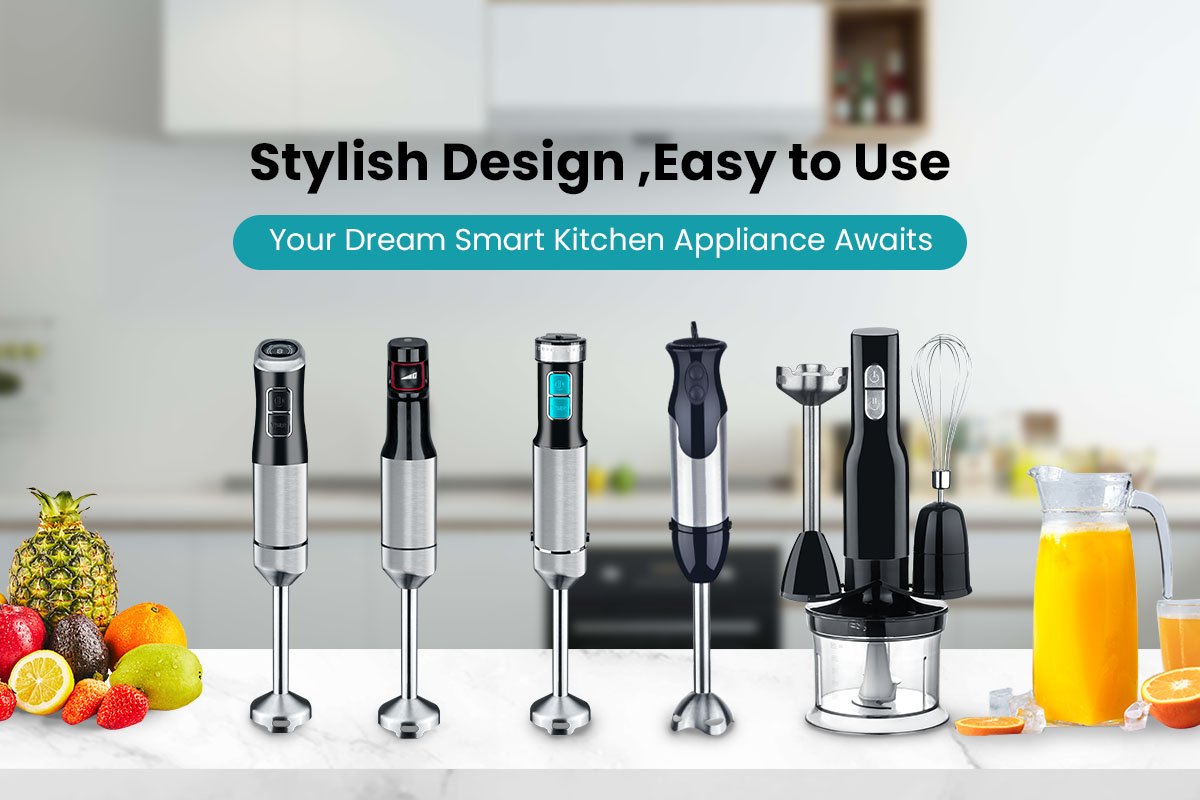
Immersion Hand Blender vs Traditional Blender: Which Appliance Has Better Market Applications?
Immersion Hand Blender offers greater flexibility and compact applications, while Traditional Blender provides stronger capacity and performance for larger-scale blending needs.
What Is the Difference Between Immersion Hand Blender and Traditional Blender?
For kitchen appliance brands, the main difference between immersion hand blender and Traditional Blender is the product structure, usage method, capacity, and target market positioning.
An Immersion hand blender is a handheld appliance that blends ingredients directly inside a container. It usually consists of a motor handle and blending shaft, offering flexible operation and easy storage.
A Traditional Blender generally refers to a countertop blender with a motor base and dedicated blending jar. It is designed for larger-capacity blending tasks and stronger blending performance.
From an OEM manufacturing perspective, these two products represent different market opportunities based on customer needs, retail channels, and product positioning.
| Comparison | Immersion Hand Blender | Traditional Blender |
|---|---|---|
| Product Structure | Handheld motor + shaft | Motor base + blending jar |
| Main Advantage | Flexibility and convenience | Capacity and blending power |
| Space Requirement | Compact | Larger footprint |
| Typical Applications | Soups, sauces, small batches | Smoothies, drinks, family use |
| Market Positioning | Convenience appliance | Performance appliance |
Why Do Brands Choose Immersion Hand Blender Products?
Immersion Hand Blender has gained popularity because of its compact structure and flexible usage.
Main advantages include:
Easy storage
Lightweight design
Direct blending operation
Lower product size
Flexible kitchen applications
For brands targeting modern household appliance markets, Immersion Hand Blender provides opportunities to develop compact and practical product lines.
Common applications include:
Small kitchen appliances
Apartment lifestyle products
Household cooking solutions
Entry-level appliance categories
From a manufacturing perspective, the simpler structure also supports efficient production and easier product management.
Why Do Brands Choose Traditional Blender Products?
Traditional Blender products remain important in markets where capacity and blending performance are key purchasing factors.
Main advantages include:
Larger blending capacity
Stronger performance positioning
Suitable for beverage preparation
Better for family applications
Common applications include:
Smoothie preparation
Juice and beverage markets
Family kitchen appliances
Higher-capacity blending tasks
For brands focusing on performance-oriented product categories, Traditional Blender provides stronger opportunities for feature-based marketing.
Which Appliance Has Wider Market Applications?
The market application depends on customer habits and product positioning.
Immersion Hand Blender Applications
Suitable for:
Household cooking
Soup preparation
Sauce mixing
Baby food preparation
Compact kitchen solutions
Its advantage is flexibility because users can blend directly in different containers.
Traditional Blender Applications
Suitable for:
Smoothie products
Beverage preparation
Family kitchen use
Larger ingredient processing
Its advantage is capacity and stronger blending performance.
Both products serve different customer needs rather than replacing each other completely.
Which Product Provides Better OEM Development Opportunities?
Both products offer OEM potential, but customization focuses on different areas.
Immersion Hand Blender OEM Opportunities
Customization may include:
Motor power
Shaft material
Handle appearance
Speed control
Accessory combinations
Packaging design
Brands can create different versions based on market requirements.
Traditional Blender OEM Opportunities
Customization may include:
Motor performance
Jar capacity
Blade design
Control panel
Housing appearance
Product functions
Traditional Blender provides more opportunities for performance-focused product development.
Which Product Is Easier for Mass Production?
Manufacturing requirements vary between the two categories.
Immersion Hand Blender Production
Advantages:
Compact structure
Fewer components
Efficient assembly
Easier packaging
Quality control focuses on:
Motor performance
Shaft connection
Electrical safety
Switch durability
Traditional Blender Production
Requires attention to:
Motor base assembly
Jar sealing
Blade balance
Noise control
Complete performance testing
For OEM buyers, supplier manufacturing capability is important for maintaining consistent quality.
How Does Product Size Affect Market Positioning?
Product size influences both consumer preference and supply chain planning.
Immersion Hand Blender Advantages
Smaller storage space
Lower transportation volume
Easier product handling
Suitable for compact living environments
Traditional Blender Advantages
Larger capacity
Stronger visual product presence
Suitable for family-oriented markets
Supports performance-based positioning
Brands should select product size based on target customers and sales channels.
Which Product Has Better Cost Control for Different Markets?
Cost structure differs due to product design.
Immersion Hand Blender often provides advantages in:
Lower material usage
Smaller packaging
Reduced shipping cost
Simpler production process
Traditional Blender may require higher investment because of:
Larger motor systems
Blending jars
Additional components
More complex testing
However, higher specifications can also support stronger retail positioning.
How Should Brands Choose Between Immersion Hand Blender and Traditional Blender?
Brands can evaluate:
Choose Immersion Hand Blender When:
Compact design is important
Flexible applications are required
Household convenience is the focus
Lower-cost product positioning is needed
Choose Traditional Blender When:
Capacity is important
Performance is the main selling point
Beverage applications are targeted
Family users are the main customers
The right choice depends on market demand, customer expectations, and product strategy.
How Can a Hand Blender Manufacturer Support Different Product Applications?
A professional kitchen appliance manufacturer can support brands through:
Product selection guidance
OEM customization
Product structure development
Prototype testing
Quality inspection
Mass production management
Manufacturers with experience in different blending product categories can help brands develop solutions suitable for various markets.
Conclusion: Immersion Hand Blender or Traditional Blender, Which Has Better Market Applications?
Immersion Hand Blender provides strong market opportunities through flexibility, compact design, and convenience, while Traditional Blender performs well in markets requiring higher capacity and stronger blending performance.
For kitchen appliance brands, the suitable product depends on target customers, application scenarios, and long-term market positioning.