




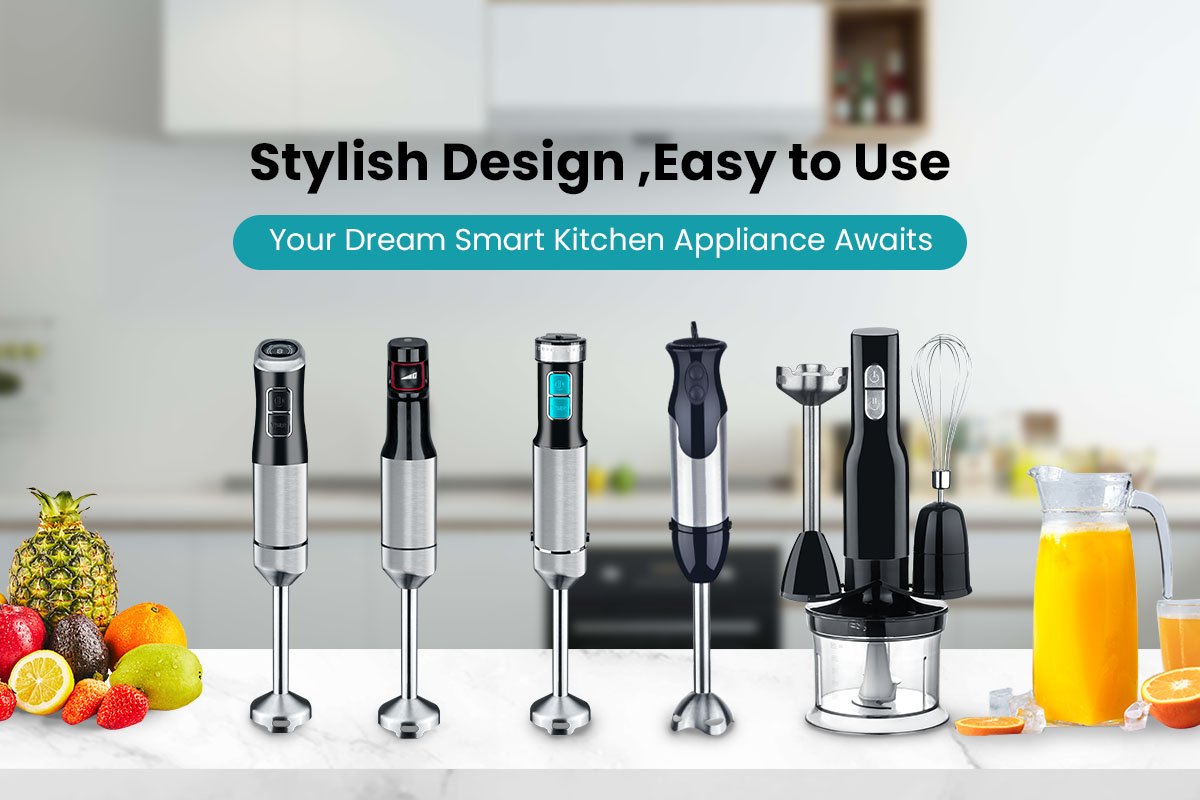
Immersion Hand Blender with Whisk Attachment vs Basic Model: Which Supports More Applications?
Immersion Hand Blender with Whisk Attachment supports more kitchen applications through multifunction capability, while Basic Model provides advantages in simplicity, cost efficiency, and easy production.
What Is the Difference Between Immersion Hand Blender with Whisk Attachment and Basic Model?
For kitchen appliance brands, the main difference between immersion hand blender with Whisk Attachment and Basic Model is the accessory configuration, product functions, and target market positioning.
A Basic Immersion hand blender focuses on core blending functions. It usually includes a motor handle and blending shaft for preparing soups, sauces, and soft ingredients.
An Immersion Hand Blender with Whisk Attachment adds a whisk accessory, allowing the product to perform additional tasks such as mixing eggs, whipping cream, and preparing lighter food ingredients.
From an OEM manufacturing perspective, accessory configuration directly affects product value, packaging options, production requirements, and retail positioning.
| Comparison | Basic Immersion Hand Blender | With Whisk Attachment |
|---|---|---|
| Main Function | Blending | Blending + whisking |
| Product Components | Motor unit + shaft | Motor unit + shaft + whisk |
| Application Range | Basic food preparation | Wider kitchen applications |
| Product Value | Practical | Higher perceived value |
| OEM Complexity | Lower | Higher |
Why Do Brands Choose Basic Immersion Hand Blender Models?
Basic Immersion Hand Blender models remain popular because they provide a simple and efficient kitchen solution.
Main advantages include:
Simple product structure
Lower production cost
Easier quality control
Faster manufacturing process
Competitive retail pricing
For brands targeting large-volume markets, basic models can provide stable supply and easier inventory management.
Common applications include:
Soup preparation
Sauce mixing
Baby food preparation
Everyday household blending
Because the product function is straightforward, customers can quickly understand its value.
Why Does Whisk Attachment Expand Product Applications?
Adding a whisk attachment allows Immersion Hand Blender products to cover more kitchen tasks.
Additional applications may include:
Egg mixing
Cream whipping
Batter preparation
Light ingredient blending
This creates a broader product usage range compared with basic models.
For brands, the whisk attachment can help transform a simple appliance into a more complete kitchen preparation solution.
Retail benefits include:
More functions in one package
Higher product value perception
Stronger product differentiation
More attractive product presentation
Which Product Provides Better OEM Opportunities?
Both product types offer OEM possibilities, but the development focus is different.
Basic Immersion Hand Blender OEM Options
Common customization includes:
Housing appearance
Motor power
Speed settings
Shaft material
Product color
Packaging design
The main goal is creating reliable and cost-effective products.
Immersion Hand Blender with Whisk Attachment OEM Options
Additional customization may include:
Accessory combinations
Whisk design
Package configuration
Product set structure
Retail presentation
This provides brands with more options for creating different product versions.
Which Product Has Wider Kitchen Applications?
The application range is one of the biggest differences between the two products.
Basic Model Applications
Suitable for:
Soup blending
Sauce preparation
Ingredient mixing
Everyday cooking tasks
Whisk Attachment Model Applications
Suitable for:
All basic blending functions
Egg preparation
Cream whipping
Baking-related preparation
More complex kitchen tasks
For consumers seeking one appliance for multiple tasks, accessory models provide stronger flexibility.
How Does Accessory Configuration Affect Retail Value?
Accessory configuration influences how customers evaluate product benefits.
A Basic Immersion Hand Blender mainly provides:
Essential blending function
Affordable pricing
Simple operation
A model with whisk attachment provides:
More preparation options
Better convenience
Higher perceived value
Stronger product positioning
For retailers, accessory-based product versions also allow different price ranges within the same product category.
Example:
| Product Version | Configuration |
|---|---|
| Basic Model | Blending shaft |
| Standard Set | Blending shaft + whisk attachment |
| Complete Set | Multiple accessories |
This structure helps brands create product tiers.
Which Product Is Easier for Mass Production?
Manufacturing requirements vary between the two configurations.
Basic Model Production Advantages
Fewer components
Simpler assembly
Lower inspection requirements
Faster production efficiency
Quality control mainly focuses on:
Motor performance
Shaft connection
Electrical safety
Product appearance
Whisk Attachment Model Production Considerations
Additional quality checks include:
Attachment connection strength
Whisk durability
Accessory compatibility
Complete package inspection
Manufacturers need effective component management to ensure consistent product quality.
How Does Product Choice Affect Cost and Pricing?
Cost structure depends on components and product positioning.
Basic Model Advantages:
Lower material cost
Reduced packaging requirements
Easier inventory management
Suitable for competitive pricing
Whisk Attachment Model Advantages:
Higher product value
More functions
Better premium positioning
Increased retail flexibility
Although accessory models may require higher production costs, they can support stronger market differentiation.
Which Product Is Better for Different Sales Channels?
Sales channels influence product selection.
Basic Immersion Hand Blender Fits:
Supermarkets
Entry-level appliance stores
High-volume retail channels
Price-focused markets
Whisk Attachment Model Fits:
Online marketplaces
Premium kitchen appliance stores
Brand-focused retail channels
Complete kitchen solution categories
Online channels especially benefit from multifunction product presentations because additional functions are easier to communicate.
How Should Brands Choose Between Basic Model and Whisk Attachment Model?
Brands can evaluate:
Choose Basic Immersion Hand Blender When:
Cost control is important
Simple products are preferred
Large-volume orders are expected
Basic kitchen functions are enough
Choose Whisk Attachment Model When:
More applications are needed
Higher product value is desired
Product differentiation matters
Premium positioning is planned
The best choice depends on target customers, market requirements, and brand strategy.
How Can a Hand Blender Manufacturer Support Product Development?
A professional Hand Blender manufacturer can provide:
Product structure evaluation
Accessory configuration support
OEM customization
Prototype production
Quality testing
Packaging solutions
Bulk production management
Manufacturers with experience in Immersion Hand Blender production can help brands develop suitable products for different markets.
Conclusion: Immersion Hand Blender with Whisk Attachment or Basic Model, Which Supports More Applications?
Immersion Hand Blender with Whisk Attachment supports more applications because it combines blending and whisking functions in one product package. Basic Immersion Hand Blender remains suitable for brands focusing on simplicity, cost efficiency, and high-volume production.
For kitchen appliance brands, the right choice depends on customer needs, sales channels, and product positioning.