




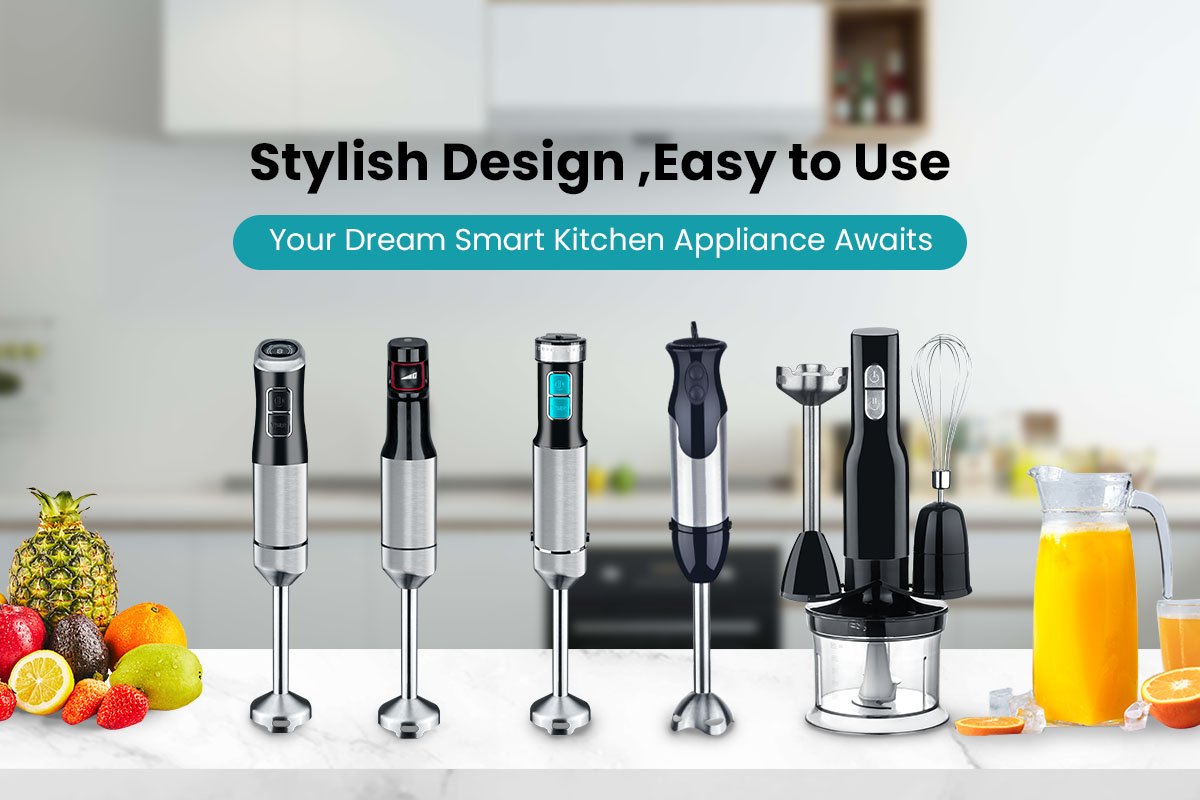
Multifunction Hand Blender vs Standard Hand Blender: Which Creates More Competitive Products?
Multifunction Hand Blender creates more competitive products through wider applications and stronger differentiation, while Standard hand blender provides advantages in simplicity, cost control, and efficient production.
What Is the Difference Between Multifunction Hand Blender and Standard Hand Blender?
For kitchen appliance brands, the main difference between Multifunction Hand Blender and Standard Hand Blender is the function range, product configuration, market positioning, and customer value.
A Standard Hand Blender focuses on the core blending function. It usually includes a motor unit and blending shaft, providing a simple solution for everyday food preparation.
A Multifunction Hand Blender expands product capability through additional accessories and functions, allowing one product to complete multiple kitchen tasks.
From an OEM manufacturing perspective, the choice between these two products affects product competitiveness, retail positioning, customization opportunities, and long-term brand development.
| Comparison | Standard Hand Blender | Multifunction Hand Blender |
|---|---|---|
| Main Function | Basic blending | Multiple kitchen functions |
| Product Configuration | Simple structure | Accessories and attachments |
| Product Value | Practical | Higher perceived value |
| Market Differentiation | Moderate | Stronger |
| Manufacturing Complexity | Lower | Higher |
Why Do Brands Choose Standard Hand Blender Products?
Standard Hand Blender remains an important product category because of its straightforward design and efficient production advantages.
Main benefits include:
Simple product structure
Lower manufacturing cost
Faster production process
Easier inventory management
Competitive retail pricing
For brands focusing on large-volume sales, standard models provide a reliable foundation for product distribution.
Common applications include:
Soup blending
Sauce preparation
Basic food processing
Everyday household cooking
Because the product function is easy to understand, Standard Hand Blender can quickly enter different retail markets.
Why Does Multifunction Hand Blender Create More Competitive Products?
Multifunction Hand Blender creates stronger competitiveness by combining multiple functions into one product solution.
Common configurations include:
Blending shaft
whisk attachment
Chopping bowl
Additional blades
Mixing accessories
These functions allow brands to offer more value without requiring customers to purchase multiple separate appliances.
Competitive advantages include:
Broader application range
Higher customer value perception
More attractive retail presentation
Stronger product differentiation
For brands competing in crowded kitchen appliance markets, multifunction features can help products stand out.
Which Product Provides Better Market Differentiation?
Market differentiation is an important factor for brand growth.
Standard Hand Blender Differentiation
Brands usually compete through:
Price advantage
Product reliability
Simple operation
Distribution efficiency
However, similar product structures may create stronger price competition.
Multifunction Hand Blender Differentiation
Brands can differentiate through:
Unique accessory combinations
Customized functions
Premium packaging
Complete kitchen solutions
This provides more opportunities to build a recognizable product identity.
Which Product Offers Better OEM Customization Opportunities?
Both products support OEM development, but customization focuses on different areas.
Standard Hand Blender OEM Options
Common customization includes:
Housing appearance
Motor specifications
Product colors
Speed settings
Packaging design
The focus is usually improving cost efficiency and product reliability.
Multifunction Hand Blender OEM Options
Additional customization includes:
Accessory selection
chopper bowl design
Whisk configuration
Product set structure
Function combinations
The wider customization range allows brands to create products for different market segments.
How Do Accessories Improve Product Competitiveness?
Accessories can significantly influence how customers evaluate product value.
A Standard Hand Blender mainly provides:
Basic blending function
Simple usage
Lower purchase cost
A Multifunction Hand Blender provides:
More kitchen applications
Higher convenience
Complete preparation solution
Stronger product appeal
For retailers, different accessory combinations also allow brands to create multiple product versions.
Example:
| Product Version | Configuration |
|---|---|
| Standard Model | Blending shaft |
| Multifunction Basic Set | Blending shaft + whisk |
| Complete Set | Blending shaft + whisk + chopping bowl |
Which Product Is Easier to Manufacture?
Manufacturing requirements are different between the two categories.
Standard Hand Blender Production Advantages
Fewer components
Simple assembly
Lower production complexity
Efficient quality management
Key inspection points:
Motor performance
Electrical safety
Shaft connection
Product appearance
Multifunction Hand Blender Production Requirements
Additional controls include:
Accessory compatibility
Component matching
Attachment durability
Complete package inspection
Manufacturers need stronger production management to maintain consistency.
How Does Cost Affect Product Competitiveness?
Product competitiveness depends on both cost and customer value.
Standard Hand Blender Cost Advantages:
Lower production investment
Easier pricing control
Suitable for high-volume markets
Lower inventory complexity
Multifunction Hand Blender Value Advantages:
Higher perceived value
More functions
Stronger premium positioning
Better differentiation opportunities
For brands, a higher-value product may provide better market opportunities when customers recognize additional functions.
Which Product Fits Different Sales Channels?
Sales channels influence product selection.
Standard Hand Blender Fits:
Supermarkets
General appliance retailers
Entry-level product categories
Price-focused markets
Multifunction Hand Blender Fits:
Online marketplaces
Premium appliance stores
Brand-focused channels
Complete kitchen solution categories
Online channels often provide more space to demonstrate multifunction advantages through product comparisons.
How Should Brands Choose Between Multifunction and Standard Hand Blender?
Brands can evaluate:
Choose Standard Hand Blender When:
Cost efficiency is important
Simple products are preferred
Large-volume production is required
Basic functions meet customer needs
Choose Multifunction Hand Blender When:
Product differentiation is important
Higher product value is needed
Multiple applications are required
Premium positioning is planned
The right choice depends on customer demand, market strategy, and product goals.
How Can a Hand Blender Manufacturer Support Competitive Product Development?
A professional Hand Blender manufacturer can support brands through:
Product planning
Function configuration
OEM customization
Prototype development
Performance testing
Quality control
Production management
Manufacturers with experience in different Hand Blender configurations can help brands create products suitable for competitive markets.
Conclusion: Multifunction or Standard Hand Blender, Which Creates More Competitive Products?
Multifunction Hand Blender creates stronger competitive products through wider applications, higher perceived value, and greater customization opportunities. Standard Hand Blender remains suitable for brands focusing on simple products, cost control, and efficient mass production.
For kitchen appliance brands, the ideal product strategy depends on target customers, sales channels, and long-term market positioning.