




What Risks Should Buyers Consider When Choosing Low-Cost Blender Suppliers?
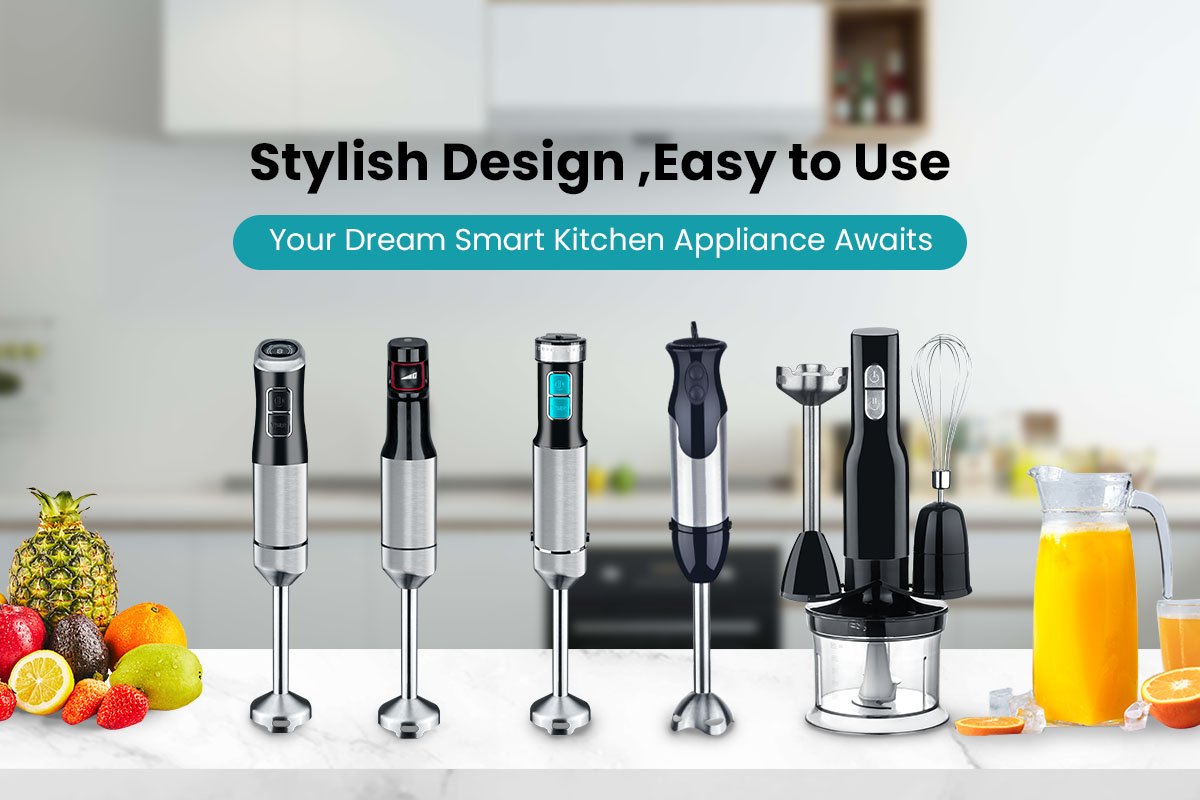
Low pricing can look attractive in the early stage of sourcing, but the lowest quote often hides the highest long-term risk. In blender procurement, cost pressure usually shows up in weaker materials, unstable motors, simplified testing, limited customization support, or poor export documentation. That is why buyers should evaluate a blender manufacturer not only by unit price, but also by production control, engineering capability, compliance readiness, and delivery stability. KANGJIA presents itself as a small home appliance manufacturer integrating development, production, and sales, with product coverage including Hand Blenders, Table Blenders, Nutrition Blenders, and mini choppers. Its public information also highlights over 250 kitchen appliance models, which is a useful sign of platform depth and product continuity.
Manufacturer Vs Trader Risk
One of the first risks behind a low quote is that the supplier may not be the real producer. A trader can offer a lower entry price to win the order, but production control may still depend on outside factories. That creates uncertainty in lead time, quality correction, tooling follow-up, and repeat-order consistency. KANGJIA states that it has its own injection shop, hardware shop, assembly shop, and motor shop, along with its own R&D department and testing room. For buyers comparing a low-cost offer with a stable OEM blender supplier, this kind of in-house structure matters because it gives clearer control over quality and production scheduling.
OEM And ODM Process Risk
Cheap suppliers often look competitive because they simplify the front-end quotation, but they may not have a complete OEM / ODM process behind the offer. In practice, that can mean slow sample revisions, unclear branding support, weak packaging development, or repeated errors during approval. KANGJIA’s published technical content on blender-related development points to prototype validation, repeated start-stop cycle testing, heat-rise testing, and splash-control evaluation, all of which are critical checkpoints when a project needs customized performance rather than a generic catalog item. A low-cost supplier that cannot manage these stages well may create delays and hidden costs later.
Manufacturing Process Overview Risk
Another major risk is weak production planning. Buyers should always ask for a clear manufacturing process overview before placing bulk orders. KANGJIA’s own lead-time article explains that blender production typically includes component inspection, motor assembly, blade installation, housing assembly, and final product testing. The same article states that production preparation normally takes about 5 to 10 days, standard manufacturing often requires 20 to 35 days, quality inspection takes 3 to 5 days, and packaging plus export preparation needs 3 to 7 days. When a supplier gives an unrealistically short timeline without this structure, the risk of rushed output and unstable quality rises sharply.
Quality Control Checkpoint Risk
The most common problem with very low-cost blender suppliers is not visible in the quotation. It appears after delivery, when units show unstable blending performance, leakage, abnormal noise, or short service life. That is why quality control checkpoints should be reviewed carefully. KANGJIA says it uses rigorous quality checks and has its own testing room, while its technical content highlights engineering validation under demanding conditions. Buyers should confirm incoming inspection, motor testing, blade balance checks, sealing verification, and final functionality testing before shipment. A supplier that saves money by reducing these checks may cost far more in claims and replacements later.
Material Standards And Compliance Risk
Low-cost offers are also risky when they rely on downgraded materials or incomplete compliance planning. For food-contact blender parts, the EU framework under Regulation EC No 1935/2004 sets general principles of safety and inertness for food contact materials. For electrical safety, IEC 60335-2-14:2025 covers kitchen machines including blenders and applies to appliances with rated voltage not more than 250 V. On the environmental side, the European Commission states that RoHS currently restricts ten substances in electrical and electronic equipment. A supplier that does not control material standards used or export testing requirements may create customs, certification, or market-entry problems. KANGJIA publicly states that its products have passed GS, CE, CB, LFGB, RoHS, and REACH related certifications, which gives buyers stronger confidence than a price-only offer.
Bulk Supply Considerations
Low pricing can also weaken supply stability. In repeat blender programs, buyers need more than a good first sample. They need component readiness, production scheduling, inspection discipline, and export preparation that can hold up under volume. KANGJIA’s published lead-time guidance notes that factories with multiple assembly lines and integrated production systems can usually maintain more stable timelines for large orders. This is an important point for any project sourcing checklist, because a supplier that wins on price but fails during peak demand can damage the entire replenishment cycle.
Practical Risk Review Before Ordering
| Risk area | What buyers should check |
|---|---|
| Manufacturer or trader | Whether the supplier controls real production |
| OEM and ODM support | Sampling, branding, packaging, engineering response |
| Production planning | Realistic lead time and assembly workflow |
| Quality control | Incoming checks, in-process control, final testing |
| Material standards | Food-contact suitability and electrical safety basis |
| Export compliance | CE, RoHS, LFGB, documentation readiness |
| Bulk supply stability | Repeat-order consistency and peak-season capacity |
Final View
The real danger of choosing a low-cost blender supplier is not the quote itself, but what may be missing behind it. Buyers should look closely at manufacturer identity, OEM and ODM capability, manufacturing flow, quality checkpoints, material standards, and export compliance. Based on KANGJIA’s public information, the company shows several strengths that reduce these risks, including integrated in-house production, internal R&D and testing support, broad product coverage, and established certification awareness.