




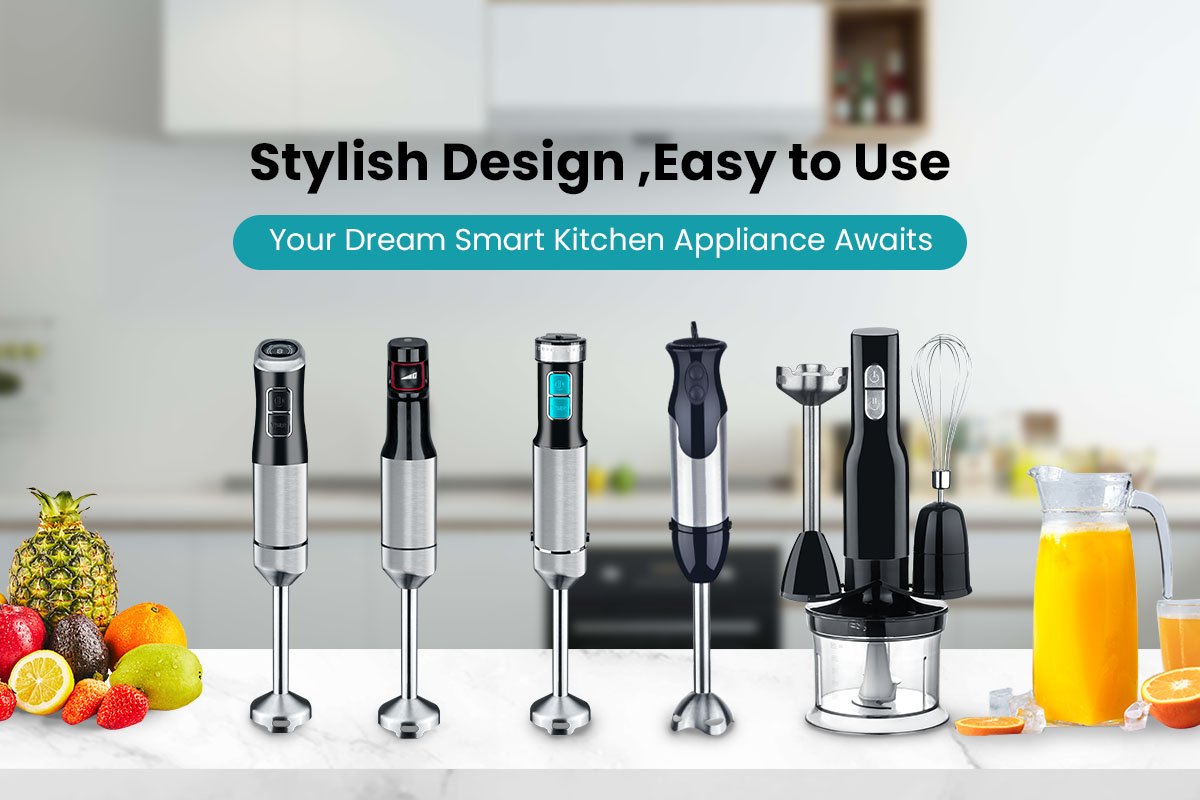
How To Choose A Reliable Hand Blender Manufacturer for Bulk Orders
Choosing a reliable Hand Blender manufacturer for bulk orders requires more than checking price and appearance. A stable supplier should control production, customization, testing, packaging, and export compliance, because every detail can affect sales performance and after-sales risk.
China is a major sourcing base for small kitchen appliances. Hand blenders are popular because they are compact, easy to ship, and suitable for different retail and private label programs. For bulk purchasing, the key is to work with a real manufacturer, not only a trading company.
Manufacturer Vs Trader
A manufacturer can control motor matching, plastic injection, blade assembly, housing fitting, testing, and packaging directly. This helps improve consistency when the same hand blender model is ordered many times.
KANGJIA Electrical Appliances Co., Ltd. was established in 2017 in Jiangmen, Guangdong. The company focuses on hand blenders, Table Blenders, Nutrition Blenders, mini choppers, Food Processors, and juicers. Its factory setup includes injection shop, hardware shop, assembly shop, motor shop, R&D department, and testing room, which supports OEM / ODM hand blender projects.
OEM / ODM Process
A professional OEM / ODM process should start with clear product planning. Buyers need to confirm power, voltage, plug type, shaft material, blade structure, housing color, logo position, accessory set, manual language, carton design, and certification needs before sampling.
| Sourcing Point | What To Confirm |
|---|---|
| Factory Type | Direct manufacturer or trader |
| Product Details | Power, voltage, blade, shaft |
| Customization | Logo, color, packaging, manual |
| Quality Control | Motor, noise, heat, switch, packing |
| Export Compliance | CE, CB, GS, LFGB, RoHS, REACH |
Manufacturing Process Overview
Hand blender production usually includes plastic injection, motor preparation, blade processing, shaft assembly, wiring, housing fitting, function testing, cleaning, packing, and carton inspection.
Important quality control checkpoints include motor temperature rise, speed stability, blade sharpness, detachable shaft fitting, button life, power cord safety, noise level, vibration control, and packing drop protection.
Material Standards Used
For hand blenders, material selection affects both safety and user experience. Common checks include food-contact plastic parts, stainless steel blades, metal shaft options, safe sealing parts, stable plugs, and compliant labels.
KANGJIA’s public information shows certification support including GS, CE, CB, LFGB, RoHS, and REACH. These references are important for export market compliance, especially for Europe and other international markets.
Bulk Supply Considerations
Before placing bulk orders, buyers should prepare a project sourcing checklist covering MOQ, lead time, sample approval, production capacity, spare parts, carton size, loading quantity, inspection method, warranty terms, and after-sales parts support.
A reliable hand blender manufacturer should also help review whether the selected model fits the target market, whether the packaging is strong enough for export shipping, and whether the documents match import requirements.
Why KANGJIA Is A Practical Choice
KANGJIA supports bulk hand blender supply with integrated production, product development, testing, and OEM / ODM customization. Its wider kitchen appliance range also helps buyers build a complete small appliance catalog with one factory partner.
For hand blender bulk orders, KANGJIA provides manufacturing support from sample development to shipment preparation, helping reduce sourcing risk and improve long-term supply stability.