




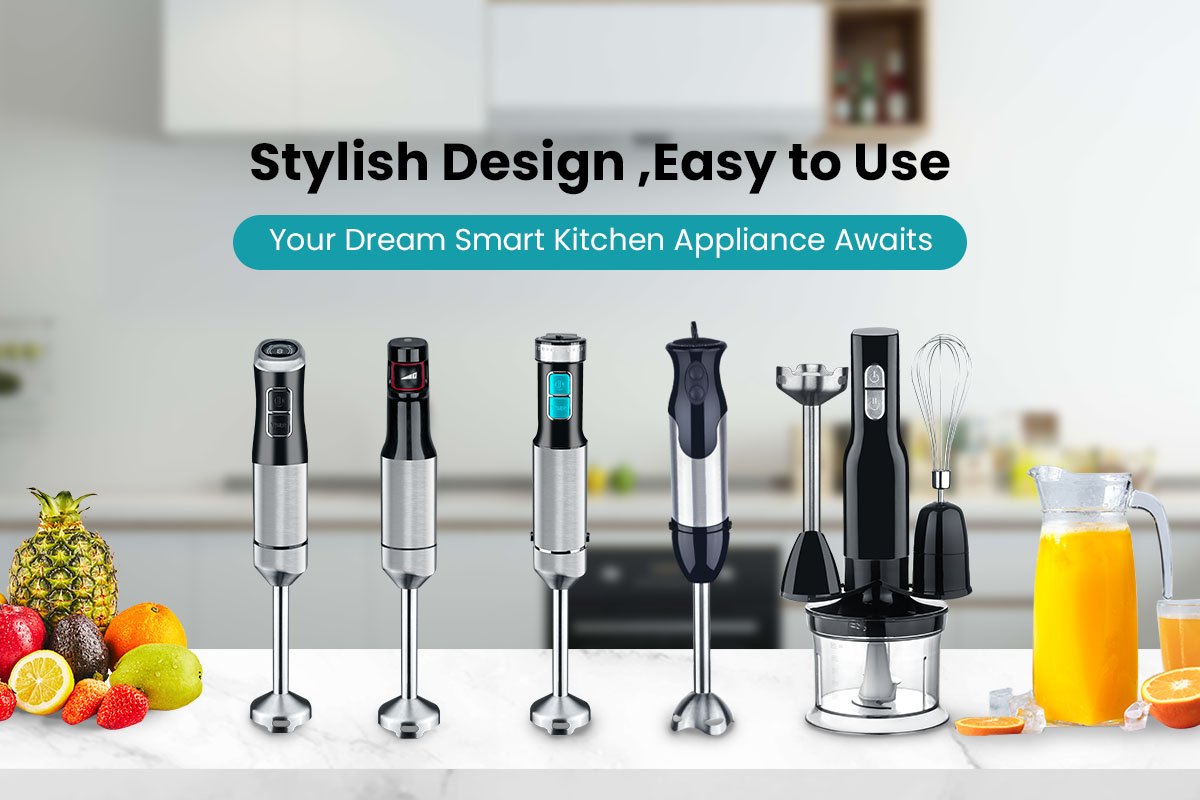
Hand Blender vs Immersion Blender: What Should Importers Consider Before Bulk Ordering?
Hand Blender and Immersion Blender usually refer to the same product category, but importers should evaluate structure, customization, quality control, and supplier capability before bulk ordering.
Are hand blender and Immersion Blender the Same Product?
For importers and kitchen appliance brands, hand blender and Immersion Blender generally describe the same type of handheld blending appliance.
The term hand blender is commonly used in product catalogs and commercial discussions, while Immersion Blender highlights the working method because the blade is immersed directly into food containers during operation.
Both products typically include:
Motor handle
Blending shaft
Stainless steel blade assembly
Speed control system
Electrical components
From an OEM purchasing perspective, the difference is not mainly the product name but the actual specifications, production quality, customization options, and supplier manufacturing capability.
| Comparison | Hand Blender | Immersion Blender |
|---|---|---|
| Product Meaning | Common commercial name | Functional description |
| Working Method | Handheld blending | Blade immersed into ingredients |
| Main Components | Motor body + shaft | Motor body + shaft |
| OEM Consideration | Model specifications | Performance and reliability |
What Should Importers Evaluate Before Bulk Ordering?
Before placing a large order, importers should evaluate more than product appearance.
Important factors include:
Motor performance
Material selection
Product durability
Safety compliance
Supplier production capability
Customization support
Quality inspection process
For kitchen appliance sourcing, a stable manufacturer should provide consistent product performance across different production batches.
A reliable bulk order process usually starts with sample evaluation, specification confirmation, production testing, and final quality inspection.
How Does Motor Performance Affect Hand Blender Selection?
The motor is one of the most important components affecting Hand Blender performance.
Importers should consider:
Motor Power
Higher motor power generally supports stronger blending performance, but the correct specification depends on the target market and application.
Speed Control
Different speed options allow brands to position products for different customer groups.
Examples:
Basic models may focus on simple blending
Multi-speed models can target premium kitchen appliance markets
Motor Stability
For bulk production, consistent motor quality is more important than only selecting a high-power specification.
Manufacturers should evaluate:
Running performance
Temperature control
Noise level
Long-term durability
Which Materials Should Importers Consider for Bulk Hand Blender Orders?
Material selection affects product appearance, durability, and market positioning.
Common considerations include:
Stainless Steel Blending Shaft
Advantages:
Better corrosion resistance
Suitable for frequent kitchen use
Premium appearance
Plastic Housing
Advantages:
Lightweight structure
Flexible color customization
Cost-effective production
For OEM projects, the combination of materials should match the target market.
Premium brands may focus on stainless steel components and refined appearance, while volume-focused products may prioritize cost efficiency and practical design.
Should Importers Choose Standard Hand Blender Models or OEM Customized Products?
The decision depends on brand strategy and order requirements.
Standard Hand Blender Models
Advantages:
Faster product launch
Lower development cost
Easier production planning
Suitable for:
New distributors
Test markets
Shorter product cycles
OEM Customized Hand Blender Models
Advantages:
Unique product appearance
Customized functions
Private label packaging
Better brand differentiation
Suitable for:
Established appliance brands
Retail chains
Long-term product development
OEM customization can include:
Logo printing
Color adjustment
Packaging design
Accessory configuration
Product structure optimization
What Quality Checks Are Important Before Mass Production?
For bulk Hand Blender orders, quality control directly affects customer satisfaction and brand reputation.
A professional manufacturing process should include inspections such as:
| Inspection Stage | Main Checking Items |
|---|---|
| Incoming Material Check | Components and material quality |
| Assembly Inspection | Product structure and connection |
| Electrical Testing | Safety and performance |
| Function Testing | Speed and blending operation |
| Final Inspection | Appearance and packaging |
For importers, understanding the supplier's quality management system helps reduce production risks.
How Does Supplier Manufacturing Capability Affect Bulk Ordering?
Choosing a manufacturer with complete production capability provides advantages in product consistency and project management.
Important supplier capabilities include:
Product development support
Component management
Assembly capacity
Testing equipment
Quality control system
Export experience
A manufacturer with integrated production processes can better manage product quality compared with suppliers that only handle trading or external sourcing.
Which Hand Blender Configuration Is Better for Different Markets?
Different markets may require different product configurations.
Entry-Level Markets
Recommended focus:
Reliable basic functions
Competitive pricing
Simple operation
Efficient packaging
Mid-Range Markets
Recommended focus:
Multiple speed options
Better materials
Improved appearance
Additional accessories
Premium Markets
Recommended focus:
Stronger performance
Stainless steel components
Customized design
Complete product sets
Importers should select configurations based on customer expectations rather than simply adding more functions.
How Can Importers Reduce Risks When Ordering Hand Blenders in Bulk?
A structured sourcing process helps reduce risks.
Recommended steps include:
Confirm product specifications
Request samples for testing
Check supplier production capability
Review quality control procedures
Confirm packaging requirements
Conduct pre-shipment inspection
These steps help ensure the final products match market requirements before large-scale distribution.
How Can a Hand Blender Manufacturer Support Importers?
A professional Hand Blender manufacturer can provide support throughout the sourcing process, including:
Product selection assistance
OEM and ODM development
Prototype samples
Production management
Quality inspection
Customized packaging
Export support
Manufacturers with experience in kitchen appliance production can help importers develop products suitable for different markets and sales channels.
Conclusion: What Should Importers Consider Before Bulk Ordering Hand Blenders?
Before bulk ordering Hand Blenders, importers should evaluate product specifications, motor performance, material quality, customization options, and supplier manufacturing capability.
A suitable Hand Blender supplier is not only able to provide products but also support stable production, quality control, and long-term cooperation.