




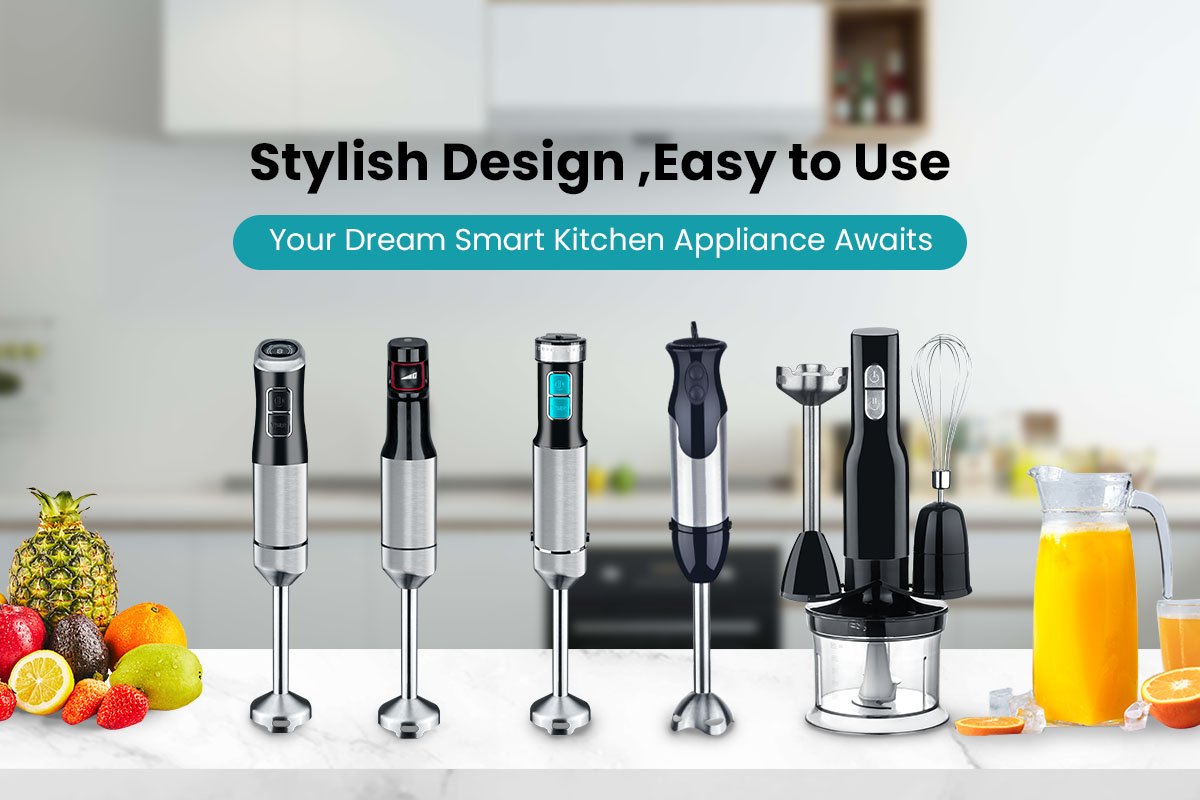
Corded Hand Blender vs Rechargeable Hand Blender: Which Fits Different Market Demands?
Corded Hand Blender suits markets that prioritize stable power and continuous operation, while Rechargeable hand blender fits portable and flexible kitchen appliance demands.
What Is the Difference Between Corded hand blender and Rechargeable hand blender?
For kitchen appliance brands, the main difference between Corded Hand Blender and Rechargeable Hand Blender is the power supply method, product structure, and target market positioning.
A Corded Hand Blender operates through a direct power connection. It provides continuous electrical power during use and is commonly designed for households that require stable blending performance.
A Rechargeable Hand Blender uses a built-in battery system, allowing operation without a fixed power connection. Its main advantages are portability, flexible usage, and improved convenience.
From an OEM manufacturing perspective, the choice between these two products affects battery technology, product cost, production requirements, and market positioning.
| Comparison | Corded Hand Blender | Rechargeable Hand Blender |
|---|---|---|
| Power Source | Direct electrical connection | Built-in rechargeable battery |
| Main Advantage | Stable and continuous power | Portable and flexible operation |
| Product Structure | Simpler electrical design | Battery and charging system required |
| Production Complexity | Lower | Higher |
| Target Market | Traditional kitchen appliance markets | Convenience-focused markets |
Which Product Provides More Stable Performance for Kitchen Appliance Brands?
Corded Hand Blender has an advantage in continuous operation because it receives direct power from an electrical outlet.
Key benefits include:
Stable motor performance
No charging limitations
Suitable for longer operation periods
Easier power management
For brands targeting traditional kitchen appliance categories, Corded Hand Blender can provide reliable performance with a relatively straightforward product structure.
Rechargeable Hand Blender depends on battery capacity and charging performance. Product design needs to balance:
Battery life
Motor power
Charging speed
Product weight
For portable appliance markets, these factors become important parts of product development.
Which Product Has Better Market Opportunities?
The suitable product depends on customer needs and sales channels.
Corded Hand Blender Market Applications
Corded models are commonly suitable for:
Household kitchen appliances
Supermarket appliance categories
Traditional retail channels
Cost-focused product lines
High-volume distribution
Their advantage is reliability and easier consumer understanding.
Rechargeable Hand Blender Market Applications
Rechargeable models are suitable for:
Portable kitchen appliance markets
Online retail channels
Compact living solutions
Modern lifestyle product lines
Premium appliance collections
Their advantage is convenience and product differentiation.
Which Product Offers Better OEM Customization Options?
Both products can support OEM development, but customization focuses on different areas.
Corded Hand Blender OEM Customization
Common customization includes:
Motor power selection
Housing appearance
Speed control design
Shaft material
Color options
Packaging design
Because the structure is relatively simple, brands can focus on appearance and performance improvements.
Rechargeable Hand Blender OEM Customization
Rechargeable models require additional considerations:
Battery capacity
Charging system
Battery protection design
Product weight balance
Charging accessories
Portable design
For brands seeking unique product concepts, rechargeable models provide more customization possibilities.
Which Product Is Easier to Manufacture and Control?
Manufacturing complexity is different between the two categories.
Corded Hand Blender Production
Main quality control points include:
Motor assembly
Electrical safety testing
Switch durability
Shaft connection strength
Performance testing
The simpler structure helps manufacturers maintain stable production efficiency.
Rechargeable Hand Blender Production
Additional quality checks are required:
Battery performance
Charging safety
Battery protection system
Operating time testing
Thermal management
Manufacturers need stronger technical capability to ensure consistent quality.
How Does Cost Influence the Choice Between Corded and Rechargeable Models?
Cost structure is an important factor for OEM buyers.
Corded Hand Blender usually has advantages in:
Lower component cost
Simpler production process
Easier quality management
Lower development requirements
Rechargeable Hand Blender may require higher investment due to:
Battery components
Charging systems
Additional testing procedures
More complex assembly
However, rechargeable models may support higher product positioning because portability creates additional market value.
Which Product Is Better for Different Customer Groups?
Different customer groups may prefer different product features.
Customers Preferring Corded Hand Blender:
Users who need regular kitchen preparation
Families with fixed kitchen spaces
Buyers focusing on practical functions
Price-sensitive markets
Customers Preferring Rechargeable Hand Blender:
Users needing flexible operation
Compact kitchen users
Portable appliance customers
Premium lifestyle markets
For importers, understanding customer behavior is more important than selecting features based only on specifications.
How Should Brands Select Between Corded and Rechargeable Hand Blender?
Kitchen appliance brands should evaluate:
Choose Corded Hand Blender When:
Stable performance is the priority
Cost control is important
Large-volume orders are expected
Traditional retail channels are targeted
Choose Rechargeable Hand Blender When:
Product innovation is required
Portability is a key selling point
Premium positioning is planned
Online channels are important
The best product choice depends on market demand, customer expectations, and brand strategy.
How Can a Hand Blender Manufacturer Support OEM Development?
A professional Hand Blender manufacturer can support both corded and rechargeable product projects through:
Product design assistance
Motor and component selection
Structure optimization
Prototype development
Performance testing
Quality control
Customized packaging
For OEM buyers, working with a manufacturer experienced in different Hand Blender structures helps improve product development efficiency.
Conclusion: Corded Hand Blender or Rechargeable Hand Blender, Which Fits Better?
Corded Hand Blender is suitable for markets that require stable performance, cost efficiency, and continuous operation. Rechargeable Hand Blender is better suited for markets focused on portability, convenience, and product differentiation.
For kitchen appliance brands, the right choice depends on target customers, sales channels, and long-term product positioning.