




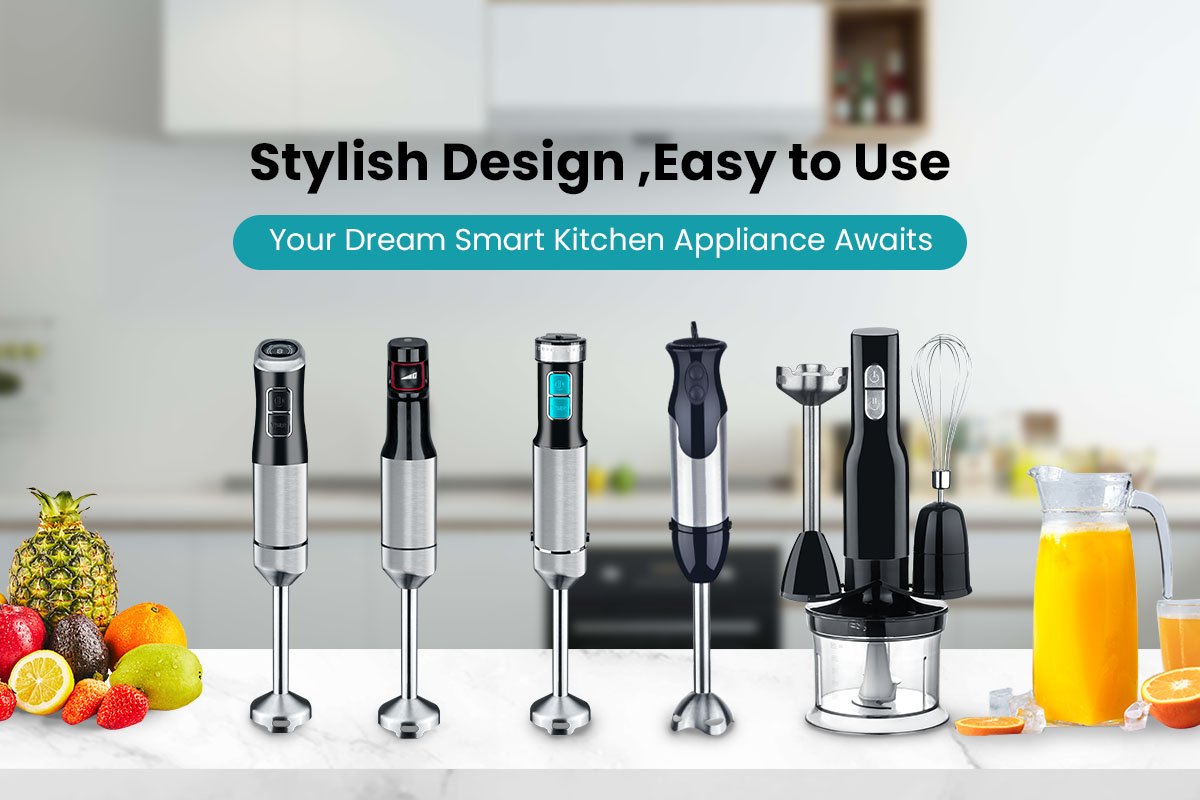
Plastic Hand Blender vs Stainless Steel Hand Blender: Which Material Is Better for Mass Production?
Plastic Hand Blender offers advantages in cost efficiency and flexible production, while Stainless Steel hand blender provides stronger durability and premium positioning for different market needs.
What Is the Difference Between Plastic hand blender and Stainless Steel hand blender?
For kitchen appliance manufacturers and importers, the main difference between Plastic Hand Blender and Stainless Steel Hand Blender is the material selection, product positioning, production cost, and market application.
A Plastic Hand Blender mainly uses plastic materials for the motor housing and external structure. It is commonly selected for lightweight designs, flexible colors, and cost-controlled production.
A Stainless Steel Hand Blender uses stainless steel components, especially on the blending shaft or key exterior areas, providing a more premium appearance and stronger resistance to wear and corrosion.
From a mass production perspective, the better material choice depends on target market requirements, product price positioning, and expected usage conditions.
| Comparison | Plastic Hand Blender | Stainless Steel Hand Blender |
|---|---|---|
| Main Material | Plastic housing/components | Stainless steel components |
| Main Advantage | Cost efficiency and design flexibility | Durability and premium appearance |
| Product Weight | Generally lighter | Generally heavier |
| Production Cost | Lower | Higher |
| Market Positioning | Mass market | Mid-range to premium market |
Why Is Plastic Hand Blender Popular for Mass Production?
Plastic Hand Blender is widely used in large-scale production because of its manufacturing flexibility and cost advantages.
Key benefits include:
Lower material cost
Lightweight product structure
Flexible color customization
Easier appearance modification
Efficient injection molding production
For brands targeting high-volume markets, plastic materials allow manufacturers to develop different product styles while maintaining competitive pricing.
Plastic housing also provides more options for product appearance design. Brands can select different colors, textures, and surface finishes to match retail positioning.
Common applications include:
Entry-level kitchen appliance lines
Large retail distribution
Online appliance stores
Promotional product categories
Why Do Brands Choose Stainless Steel Hand Blender Products?
Stainless Steel Hand Blender products are often selected for markets that emphasize durability, quality perception, and premium appearance.
Main advantages include:
Strong corrosion resistance
Better surface durability
Premium visual appearance
Suitable for frequent kitchen use
For kitchen appliance brands, stainless steel components can improve perceived product value and support higher-end positioning.
Common applications include:
Premium household appliances
Higher-value retail collections
Professional kitchen product lines
Brand-focused product categories
Which Material Provides Better Manufacturing Efficiency?
Material selection directly affects production processes.
Plastic Hand Blender Production Advantages
Plastic components usually support:
Efficient injection molding
Faster appearance changes
Easier color adjustment
Stable large-volume production
For manufacturers handling high-volume orders, plastic structures can improve production efficiency.
Stainless Steel Hand Blender Production Considerations
Stainless steel components require additional processes such as:
Metal forming
Surface treatment
Polishing
Appearance inspection
These processes can increase production requirements but also improve product durability and appearance quality.
Which Material Is Better for OEM Customization?
Both materials provide OEM opportunities, but customization focuses on different areas.
Plastic Hand Blender OEM Customization
Common options include:
Housing color
Surface texture
Handle design
Button appearance
Packaging customization
Plastic structures provide more flexibility for creating different visual styles.
Stainless Steel Hand Blender OEM Customization
Common options include:
Stainless steel shaft design
Surface finish
Metal appearance
Premium packaging
Product combination design
Stainless steel components are often used to create a stronger quality impression.
How Does Material Choice Affect Product Cost?
Cost is one of the most important factors in mass production.
Plastic Hand Blender usually provides advantages in:
Lower raw material cost
Lower production complexity
Easier assembly
Reduced transportation weight
Stainless Steel Hand Blender may require higher investment because of:
Higher material cost
Additional processing steps
More detailed quality inspection
However, higher material quality can support stronger market positioning and pricing strategies.
Which Material Offers Better Durability for Long-Term Use?
Durability depends on the complete product design, not only one material.
Important factors include:
Motor quality
Component connection
Material thickness
Manufacturing precision
Quality testing
Stainless steel components generally provide advantages in resistance to corrosion and repeated use, especially in areas that directly contact food.
Plastic components can also provide reliable performance when suitable materials and manufacturing standards are applied.
For OEM buyers, selecting the correct material combination is often more effective than choosing only one material type.
Which Material Is More Suitable for Different Markets?
Different markets have different expectations.
Plastic Hand Blender Is Suitable For:
Cost-sensitive markets
Large-volume retail
Entry-level product ranges
Brands focusing on competitive pricing
Stainless Steel Hand Blender Is Suitable For:
Premium appliance markets
Customers seeking higher quality appearance
Brands building upscale product lines
Markets emphasizing durability
The right choice depends on customer expectations, sales channels, and product positioning.
How Should Brands Choose Between Plastic and Stainless Steel Hand Blender?
Before mass production, brands should evaluate:
Choose Plastic Hand Blender When:
Cost efficiency is important
Large production volume is expected
Flexible appearance design is needed
Competitive retail pricing is required
Choose Stainless Steel Hand Blender When:
Premium positioning is required
Durability is a key selling point
Higher product value is expected
Long-term brand image is important
A balanced product strategy may also combine both materials to achieve cost control and product differentiation.
How Can a Hand Blender Manufacturer Support Material Selection?
A professional Hand Blender manufacturer can help brands evaluate:
Material suitability
Product structure
Manufacturing feasibility
Cost control
Market positioning
Quality requirements
With experience in kitchen appliance production, manufacturers can recommend suitable material solutions based on order volume, target market, and product goals.
Conclusion: Plastic or Stainless Steel Hand Blender, Which Is Better for Mass Production?
Plastic Hand Blender is suitable for brands focusing on cost efficiency, lightweight design, and large-scale production. Stainless Steel Hand Blender is better for brands seeking premium appearance, stronger durability, and higher product positioning.
For mass production, the best material choice depends on market demand, product strategy, and manufacturing requirements.