




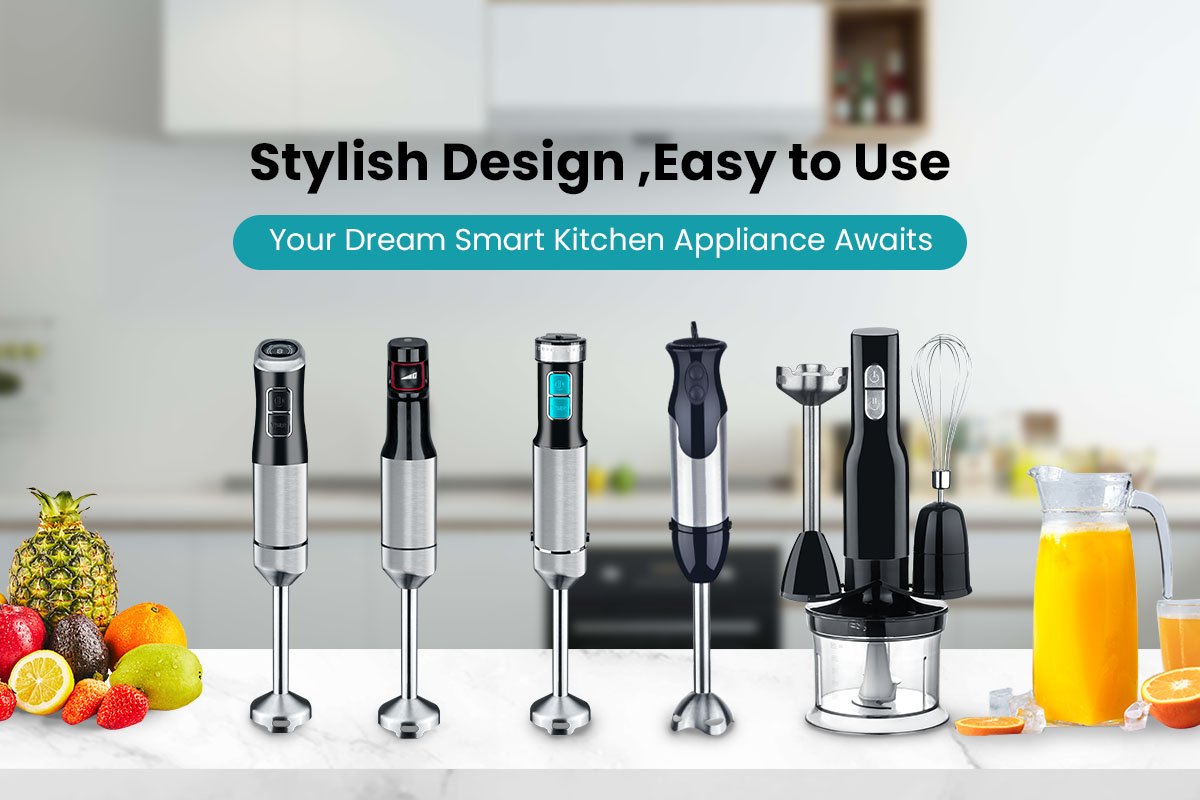
Compact Hand Blender vs Heavy Duty Hand Blender: Which Is More Suitable for Different Markets?
Compact Hand Blender fits markets that value portability and cost efficiency, while Heavy Duty hand blender is better suited for professional applications and high-performance product positioning.
What Is the Difference Between Compact hand blender and Heavy Duty hand blender?
For kitchen appliance brands, the main difference between Compact Hand Blender and Heavy Duty Hand Blender is the product structure, motor capability, usage intensity, and target market.
A Compact Hand Blender is designed with a smaller structure and lightweight design. It focuses on convenience, easy storage, and everyday household applications.
A Heavy Duty Hand Blender is developed for stronger performance requirements. It usually features a more powerful motor, stronger components, and a structure designed for longer or more demanding operation.
From an OEM manufacturing perspective, the choice between these two products affects product positioning, production requirements, and customer targeting.
| Comparison | Compact Hand Blender | Heavy Duty Hand Blender |
|---|---|---|
| Product Focus | Convenience and portability | Performance and durability |
| Structure | Lightweight design | Reinforced construction |
| Motor Requirement | Standard power | Higher performance |
| Target Users | Household consumers | Heavy-use applications |
| Market Positioning | Practical appliance | Professional-grade appliance |
Why Do Brands Choose Compact Hand Blender Products?
Compact Hand Blender products are popular because they match the needs of modern kitchens where space, convenience, and affordability are important.
Main advantages include:
Lightweight design
Easy storage
Simple operation
Lower production cost
Flexible retail positioning
For brands targeting household appliance markets, compact models can provide broader customer coverage.
Common applications include:
Small kitchen appliance collections
Apartment living solutions
Online household appliance sales
Entry-level kitchen product categories
Compact design also provides advantages in packaging and transportation, making it suitable for brands managing large-volume distribution.
Why Do Brands Choose Heavy Duty Hand Blender Products?
Heavy Duty Hand Blender products focus on stronger performance and longer operating capability.
Key advantages include:
Higher motor performance
Stronger component structure
Better durability for frequent use
Suitable for demanding applications
These products are often positioned for customers who require more than basic blending functions.
Common applications include:
Professional kitchen environments
Commercial food preparation
Higher-end household appliance markets
Users with frequent blending requirements
For brands building premium product lines, Heavy Duty Hand Blender can help create stronger product differentiation.
Which Product Provides Better OEM Opportunities?
Both Compact Hand Blender and Heavy Duty Hand Blender provide OEM opportunities, but the development focus is different.
Compact Hand Blender OEM Opportunities
Customization usually focuses on:
Appearance design
Product colors
Handle structure
Packaging solutions
Basic function configuration
The goal is usually creating attractive products with competitive pricing.
Heavy Duty Hand Blender OEM Opportunities
Customization may include:
Motor specifications
Reinforced components
Performance improvements
Professional accessories
Durability testing
The focus is creating products with stronger performance and higher market value.
Which Product Is Better for Different Market Segments?
Different markets require different product strategies.
Compact Hand Blender Is Suitable For:
Household appliance brands
Retail supermarkets
Online marketplaces
Cost-sensitive regions
First-time kitchen appliance buyers
Its advantage is accessibility and wider customer acceptance.
Heavy Duty Hand Blender Is Suitable For:
Professional users
Premium kitchen appliance markets
Commercial applications
Customers requiring frequent operation
Its advantage is performance and long-term reliability.
How Does Motor Performance Affect Product Selection?
Motor performance is one of the key differences between Compact and Heavy Duty Hand Blender products.
Compact Hand Blender Motor Requirements
The focus is usually:
Efficient daily operation
Balanced power consumption
Lightweight product design
Cost-effective performance
Heavy Duty Hand Blender Motor Requirements
The focus is usually:
Higher output capability
Longer operating periods
Better heat management
Stronger component matching
For OEM buyers, motor selection should match the expected usage environment rather than simply choosing the highest specification.
Which Product Is Easier for Mass Production?
Manufacturing requirements differ between the two categories.
Compact Hand Blender Production
Advantages:
Simpler structure
Lower assembly complexity
Easier inventory management
Efficient large-scale production
Quality control focuses on:
Motor performance
Switch reliability
Shaft connection
Electrical safety
Heavy Duty Hand Blender Production
Requires more attention to:
Motor durability
Component strength
Heat control
Long-term performance testing
Manufacturers need stronger production management to maintain consistency.
How Does Product Choice Affect Cost and Retail Positioning?
Product structure directly influences cost and pricing strategy.
Compact Hand Blender usually provides:
Lower manufacturing cost
Lower transportation cost
Easier retail pricing control
Wider market accessibility
Heavy Duty Hand Blender may involve:
Higher component cost
More testing requirements
Stronger material selection
However, the higher production investment can support premium pricing and specialized market positioning.
How Should Brands Choose Between Compact and Heavy Duty Hand Blender?
Brands should evaluate:
Choose Compact Hand Blender When:
The target market values convenience
Affordable pricing is important
Large retail coverage is needed
Lightweight design is preferred
Choose Heavy Duty Hand Blender When:
Performance is a key selling point
Customers require frequent use
Premium positioning is planned
Professional applications are targeted
The right choice depends on customer demand, sales channels, and brand strategy.
How Can a Hand Blender Manufacturer Support Different Market Requirements?
A capable Hand Blender manufacturer should provide support based on different product requirements, including:
Product structure development
Motor selection
Material recommendations
Prototype testing
Quality inspection
OEM customization
Production management
Manufacturers with experience in both compact and high-performance Hand Blender production can help brands select suitable solutions for different markets.
Conclusion: Compact Hand Blender or Heavy Duty Hand Blender, Which Is More Suitable?
Compact Hand Blender is suitable for markets that prioritize convenience, affordability, and easy daily use. Heavy Duty Hand Blender is more suitable for markets requiring stronger performance, durability, and professional applications.
For kitchen appliance brands, selecting the right product depends on market demand, customer expectations, and long-term product positioning.