




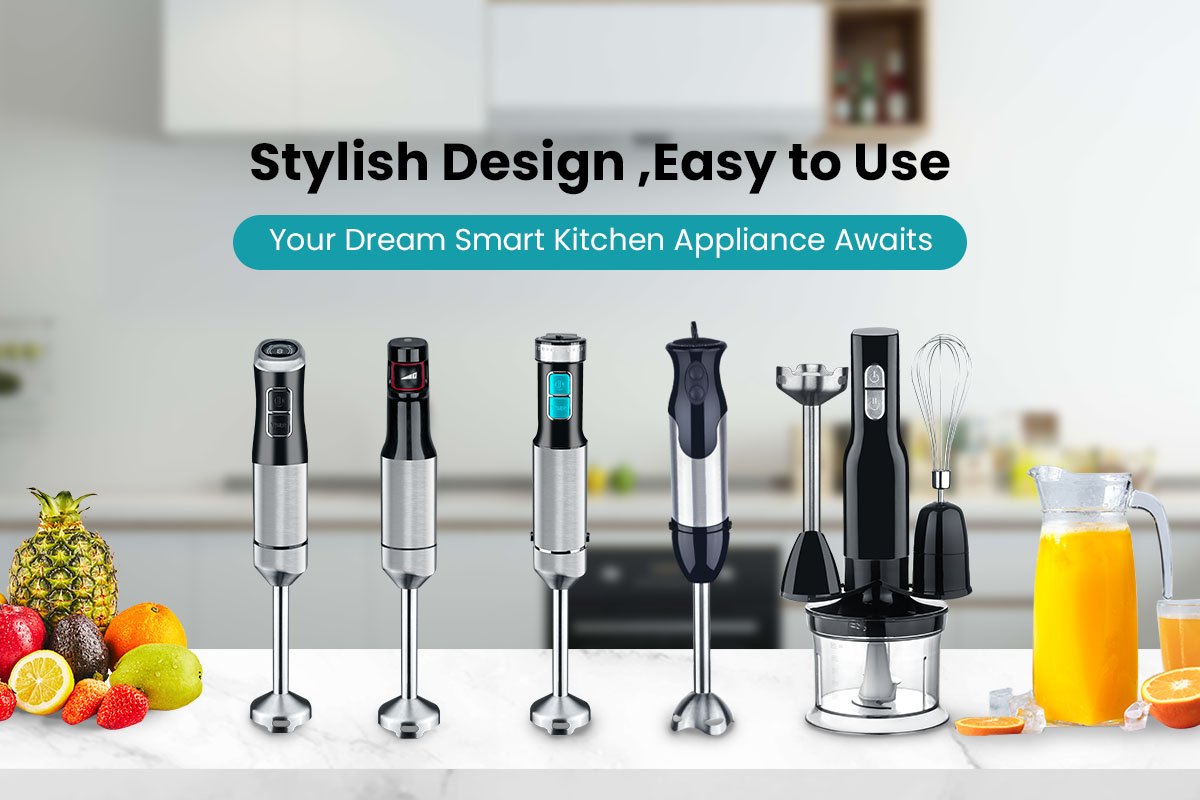
Multifunction Blender with Accessories vs Without Accessories: Which Improves Sales Value?
Multifunction Blender with Accessories usually creates higher sales value through broader applications and stronger product appeal, while models without accessories provide cost advantages and simpler product positioning.
What Is the Difference Between Multifunction Blender with Accessories and Without Accessories?
For kitchen appliance brands, the main difference between Multifunction Blender with Accessories and Without Accessories is the product configuration, application range, customer perception, packaging strategy, and market positioning.
A Multifunction Blender Without Accessories focuses on the core blending function. It provides a simplified product structure designed for customers who need basic kitchen processing.
A Multifunction Blender with Accessories includes additional components such as chopping bowls, whisk attachments, or extra blades, allowing users to complete more kitchen tasks with one product.
From an OEM manufacturing perspective, accessory configuration directly affects product value, retail presentation, production planning, and brand positioning.
| Comparison | Multifunction Blender Without Accessories | Multifunction Blender with Accessories |
|---|---|---|
| Product Configuration | Main unit only | Main unit + additional accessories |
| Application Range | Basic blending | Multiple kitchen functions |
| Customer Perception | Practical product | Complete kitchen solution |
| Packaging Value | Simple | Higher visual value |
| Market Positioning | Entry to mid-range | Mid-range to premium |
Why Do Brands Choose Multifunction Blender Without Accessories?
Multifunction Blender without accessories provides advantages in cost control and simplified product management.
Main benefits include:
Lower production cost
Smaller packaging size
Easier inventory management
Lower shipping requirements
Faster product assembly
This configuration is suitable for brands targeting customers who mainly need basic blending functions.
Common applications include:
Smoothie preparation
Sauce mixing
Soup blending
Everyday kitchen tasks
For value-focused markets, a simplified configuration can help brands maintain competitive pricing.
Typical sales channels include:
Supermarkets
Entry-level appliance stores
Large-volume distributors
Price-sensitive online categories
Why Does Multifunction Blender with Accessories Create Higher Sales Value?
Accessories can increase product value by expanding application scenarios.
Common accessories include:
These components allow users to complete more tasks, such as:
Blending
Chopping
Whisking
Ingredient preparation
For brands, accessory sets provide stronger selling points because customers can clearly understand the additional functions included in the package.
Main advantages include:
Higher perceived value
More complete product presentation
Stronger differentiation
Better retail appeal
How Do Accessories Influence Customer Purchase Decisions?
Customers often evaluate kitchen appliances based on the functions they can achieve.
Without Accessories Positioning:
Customers usually focus on:
Affordable price
Basic functions
Simple operation
Practical usage
With Accessories Positioning:
Customers usually focus on:
More applications
Better convenience
Complete kitchen solution
Higher product value
For online sales channels, accessory combinations can improve product explanation because customers can see more usage possibilities from product images and descriptions.
Which Configuration Provides Better OEM Opportunities?
Both configurations support OEM development with different customization directions.
Multifunction Blender Without Accessories OEM Options:
Common customization includes:
Product appearance
Motor specifications
Speed settings
Product colors
Packaging design
The focus is creating reliable and cost-efficient products.
Multifunction Blender with Accessories OEM Options:
Additional customization includes:
Accessory combinations
chopper bowl design
Attachment structure
Package configuration
Function combinations
The focus is creating differentiated product solutions for different markets.
How Does Accessory Configuration Affect Production?
Accessory quantity influences manufacturing processes and quality management.
Without Accessories Production Advantages:
Fewer components
Simplified assembly
Easier quality inspection
Lower production complexity
Quality control mainly focuses on:
Motor performance
Electrical safety
Main unit structure
Basic function testing
With Accessories Production Requirements:
Additional quality checks include:
Accessory compatibility
Component matching
Attachment durability
Complete package inspection
Manufacturers need effective production management to ensure every component works properly together.
Which Configuration Provides Better Retail Packaging Value?
Packaging plays an important role in product sales.
Without Accessories Packaging Advantages:
Smaller package size
Lower packaging cost
Easier transportation
Simple product presentation
With Accessories Packaging Advantages:
Stronger shelf appearance
More visible product value
Better product storytelling
More premium presentation
For retail environments, accessory sets often provide more opportunities to communicate product benefits.
How Does Accessory Configuration Affect Pricing Strategy?
Product configuration directly influences pricing possibilities.
Without Accessories Pricing Advantages:
Lower retail price
Wider customer accessibility
Suitable for high-volume sales
With Accessories Pricing Advantages:
Higher perceived value
Better premium pricing opportunities
Stronger differentiation
Brands should match accessory combinations with customer expectations rather than adding unnecessary components.
Which Configuration Fits Different Market Segments?
Different markets may require different product strategies.
Multifunction Blender Without Accessories Fits:
Price-sensitive markets
Basic household appliance categories
Large-volume retail channels
Customers seeking simple solutions
Multifunction Blender with Accessories Fits:
Premium household markets
Online retail channels
Gift appliance categories
Customers seeking multifunction products
The right configuration depends on consumer needs and market positioning.
Which Configuration Is Better for Brand Development?
Brand development goals influence product selection.
Choose Without Accessories When:
Cost efficiency is important
Basic functions meet customer demand
Large-scale sales are planned
Competitive pricing is required
Choose With Accessories When:
Higher product value is needed
Market differentiation is important
Multiple applications are preferred
Premium positioning is planned
The suitable solution depends on brand strategy, customer expectations, and sales channels.
How Can a Multifunction Blender Manufacturer Support Product Development?
A professional Multifunction Blender manufacturer can support brands through:
Product configuration planning
Accessory selection
OEM customization
Prototype development
Quality testing
Packaging solutions
Mass production management
Manufacturers with experience in different product configurations can help brands develop suitable solutions for various markets.
Conclusion: Multifunction Blender with Accessories or Without Accessories, Which Improves Sales Value?
Multifunction Blender with Accessories generally provides higher sales value through broader applications, stronger product presentation, and better customer perception. Models without accessories remain suitable for brands focusing on cost control, simple products, and large-scale distribution.
For kitchen appliance brands, the ideal configuration depends on target customers, market positioning, pricing strategy, and long-term product planning.