




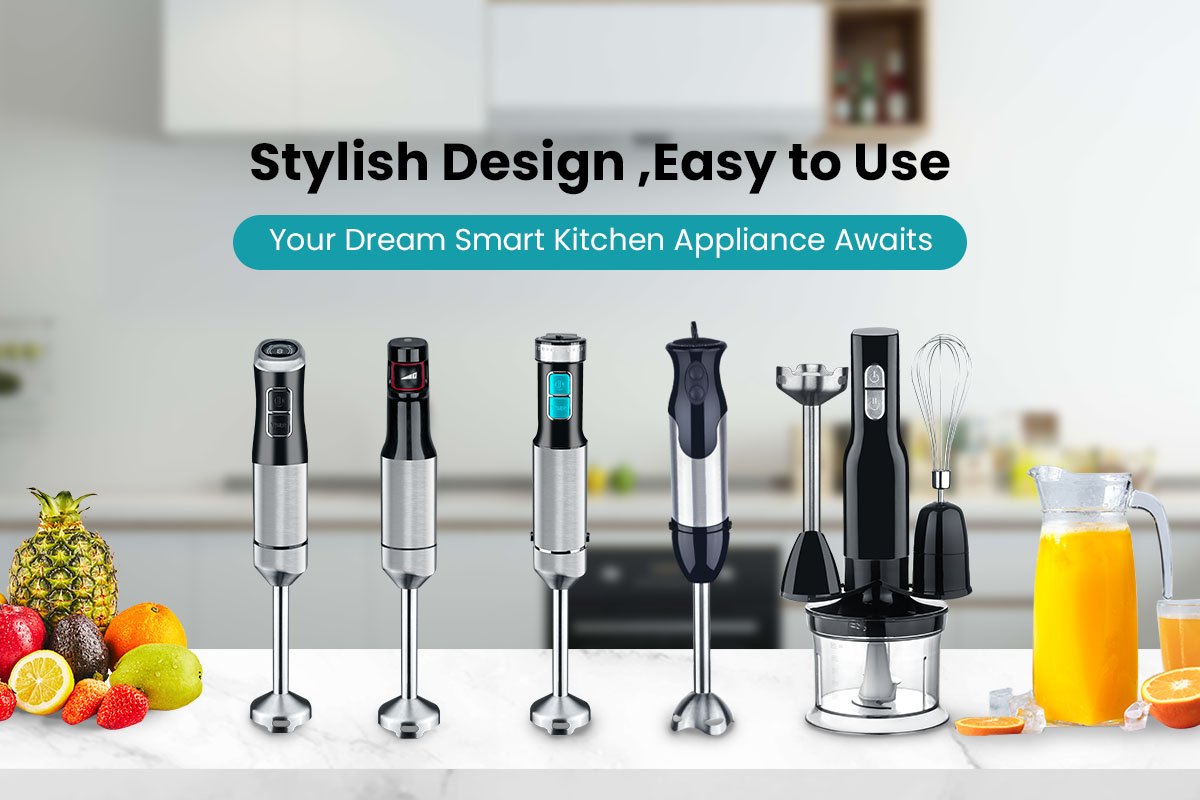
The most popular blender types worldwide include countertop blenders, hand blenders, nutrition blenders, personal blenders, and multifunction food processor blenders. Among them, countertop blenders remain one of the strongest categories because they support smoothies, soups, sauces, milkshakes, crushed ice, and family-size kitchen preparation.
-
2026-05-29
-
2026-05-06The best motor type for blenders depends on the product level, target recipe, jar capacity, speed control, and expected service life. For most household and kitchen appliance programs, a copper-wound universal motor is a practical choice because it can deliver high speed, strong starting power, and compact structure for countertop blenders, hand blenders, and nutrition blenders.
-
2026-03-02Many people associate ice cream with specialized ice cream machines, but a hand blender can also be used to make simple frozen desserts. By blending frozen fruits, cream, or yogurt mixtures, a hand blender can break down solid ingredients and create a smooth ice-cream-like texture. The final result depends largely on the motor power, blade design, and stability of the appliance.Hand blenders are versatile kitchen appliances designed for blending, pureeing, and mixing ingredients. When used with frozen components such as bananas, berries, or dairy mixtures, the rotating blades gradually break the frozen structure and combine the ingredients into a creamy consistency. Although the texture may differ slightly from churned ice cream, it can still produce satisfying homemade frozen desserts.KANGJIA Electrical Appliances Co., Ltd. is a professional manufacturer of small kitchen appliances, producing products such as hand blenders, countertop blenders, mini choppers, and food processors. The company integrates product development, manufacturing, and global sales, providing stable supply solutions for international distributors and wholesale buyers.In appliance manufacturing, product performance depends heavily on materials and production processes. Hand blenders are typically produced through motor assembly, blade manufacturing, plastic housing molding, electronic installation, and final product testing. KANGJIA operates integrated production facilities including injection workshops, hardware processing workshops, motor production lines, and assembly lines, helping maintain consistent product quality.Compared with trading companies, direct manufacturers offer better control over production and product consistency. Manufacturers can manage raw material selection, production parameters, and quality inspections within the factory, while traders usually rely on external factories for supply.KANGJIA also supports OEM and ODM cooperation for global buyers. Customization can include product design, motor specifications, blade structure, and packaging configuration. The company maintains an R&D team and testing facilities to ensure product performance during development and production.Quality control checkpoints include incoming material inspection, motor performance testing, blade durability checks, electrical safety verification, and final product functionality testing. These procedures help ensure that each appliance meets reliability standards before shipment.For international markets, kitchen appliances must also comply with export regulations. Products may require certifications such as CE, GS, CB, LFGB, RoHS, and REACH to meet safety and environmental requirements.In summary, a hand blender can be used to prepare simple ice cream by blending frozen ingredients into a creamy mixture. However, appliance quality plays a key role in achieving good results. For distributors and appliance brands sourcing in bulk, working directly with a manufacturer that controls production, quality inspection, and certification compliance helps ensure reliable product performance and stable global supply.
-
2025-11-27Yes — you can hand blend hot soup, and in fact, that’s one of the most popular and practical uses of a hand blender (also called an immersion blender). Unlike traditional countertop blenders that require you to transfer the liquid, a hand blender allows you to blend the soup directly in the pot, saving time, reducing mess, and preventing burns caused by transferring hot liquids.
-
2025-09-15A hand blender (also known as an immersion blender or stick blender) is a compact and versatile kitchen appliance that blends, purees, and mixes foods directly in the container you use them in. Unlike traditional countertop blenders, it eliminates the need for a separate blender cup, making it convenient for making soups, sauces, smoothies, and more.
-
2025-09-02A hand blender (often simply called a hand blender or hand blender) is a compact and versatile kitchen appliance that can be used to blend, mix, and puree food directly in the container you prepare it in. Unlike traditional countertop blenders, which require transferring ingredients to a large pot, a hand blender can be used in a pot, bowl, or even a tall glass.
-
2025-09-01A handheld blender (also known as an immersion blender or stick blender) is a versatile kitchen tool that can be used to blend soups, sauces, smoothies, and more directly in a pot or container. Unlike traditional countertop blenders, it's lightweight, portable, and easy to clean.
-
2024-12-11In recent years, hand blenders have become popular among both amateur home cooks and professional chefs. There are many advantages that these hand held blenders and mixers provide over their counterparts such as conventional countertop blenders and other blending appliances. For easy storage to blending that is more convenient, hand blenders have multiple advantages over the conventional countertop blenders and other blending appliances. This article will review the most notable benefits of hand blenders and will analyze why it is a viable option for almost anyone who is looking to make their cooking a bit easier.
-
2024-11-14In the context of a professional kitchen, both quality and uniformity are two major objectives in any cooking process. These may range from soups, smoothies, sauces, and batters. It is important that they have the same texture and taste when served to customers. These appliances are also useful to improve the consistency and quality of food products known as table or countertop blenders. In this article, we will examine how table blenders help in achieving these characteristics in the process of food production.
-
2024-11-14Through this article, the reader should be able to comprehend the fundamental features and principals that govern both immersion and traditional countertop blenders. In most home and commercial kitchens blenders are an unarguable component when preparing blenders. Foods may include smoothies, sauces, soups, and purees among many others. Let us first emphasize that immersion hand blenders and traditional blenders have their own distinct differences which remains to be the challenge on when to use which. Other studies have previously indicated that when it comes to culinary performance, blend’s functionality and physical features may highly influence the type of blender one decides to use.